
So I've been doing these VS analysis blogs for a while now and eventually they start to get a bit samey. You can only write so many matchups that basically boil down to “big number beats small number” before it gets tedious.
So, I aim to challenge myself. I want to get into the characters and media that are “weird” to analyze from a power scaling standpoint.
Dungeons and Dragons, moreover Tabletop games as a whole, are a unique form of media that is free-form and can actively be determined and altered by the people consuming it. This makes it difficult to analyze, as feats, equipment and power sets are often determined by the people at the table playing it.
There are, however, novels, guides and manuals that give an outline of how the characters are meant to be played as written, and how the lore goes officially outside of player interference.
It's like a delicate balancing act, trying to create a collaborative experience for everyone, making sure each person has fun, but not too much as to take it away from other players.
Though, with many communities, there are going to be a few bad apples that spoil the bunch, “That Guy”, the problem player, or arguably worse, the problem DM that sees the game as a form of competition against the players, and must always one-up them.
Metatextually, Acererak represents the petty DM who wants to punish their players.
I've run games before, and being the host for a world for other people to step into can give you a bit of a power trip, but it's also an overwhelming responsibility to make sure it's a fun experience for your players. Sometimes (ok, almost all the time) you have a perfectly laid out plan, you've put hours of your own free time into your game and your sessions, only for players to completely derail and circumvent the challenges you've laid out before them.
Sometimes, your players will get overly greedy, becoming loot goblins for every shiny gold piece and magic item, always expecting more when you feel you've already been generous enough.
Sometimes, your players find some exploit in the rules to cheese your encounters and challenges.
Sometimes, your players kill off a character you had attachment to or had plans for.
Sometimes, DMing becomes frustrating because you're putting your own fun aside for the players’ sake. And sometimes… you want to punish them for it.
Enter: The Tomb of Horrors.
In 1975, DnD co-creator Gary Gygax released a module designed as “a challenge for high level players who thought they were invincible”, which demonstrated the absolute, unchecked wrath of the adversarial DM.
Tomb of Horrors is known for its instant death traps, and “gotcha” level design intended to punish metagaming and power gamers for their hubris.
Its architect was Acererak (Pronounced Ah-SARE-rack), the undead lich obsessed with consuming souls, as well as putting brash and pompous adventurers in their place.
If you were to ask anyone who the final boss of DnD is, most would say it's Vecna, simply because he's a series mainstay and has a lot of external media hype surrounding him. However, Acererak also has that going for him, in addition to the fact that no boss monster or BBEG is as horrifying as simply stepping through a hallway and the DM turning to you and saying “You are completely and forever destroyed. There is no appeal.”
Acererak exists as a reminder for players to play cautious and stay humble, and for the DMs not to abuse their power, lest they invite Acererak to their table, be it in game or in spirit.
Because when the trust between DMs and players is broken, the game is destroyed.
Background

As with many villains, Acererak's backstory is a tragic one. Born as offspring of a Baalor demon and his female human captive, he was rejected and outcast by his father for his mere existence.
His mother escaped with baby Acererak in tow, and they fled to the nearest civilization. Everywhere they went, however, they were ostracized due to Acererak's demonic appearance.
Eventually they were hunted down, killing his mother in an angry mob. Acererak grew to hate not just humanity, but his own existence. From there he developed an intense loathing for those who felt superior, much like his father, as well as those who rejected him.
With nowhere left to go, he was taken in by the lich Vecna, who took the young Acererak in not out of pity, but because he believed his power as a Cambion (half-demon) would be useful to him. Vecna taught him Necromancy, and eventually how to become a lich, a long process that involves dying and using necromancy to animate one's own corpse, effectively achieving immortality and transcending the living plane via cheating death.
Acererak rose quickly in the ranks, becoming Vecna's top general. He would use his position to get inside Vecna's vault, betraying him and stealing his secrets.
The two became rivals ever since, Vecna becoming obsessed with overthrowing gods to become a deity, and Acererak despising him for his pompousness.
Eventually Acererak gave up on fighting Vecna directly since the two could never kill each other permanently, and would instead pursue his own methods of becoming more powerful.
He would travel around the planes, collecting creatures, artifacts, and materials in order to build dungeons that were essentially elaborate deathtraps that served a dual purpose. One, to kill whoever steps inside and feast on their souls, and two, to punish those who wronged him in life a thousandfold.
Powers and Abilities

Frightening Gaze
Acererak has the non-magical ability to paralyze people with fear by looking at them.
Resistance and Immunities
Acererak is resistant to cold and lightning damage. He also cannot be harmed by conventional melee weapons such as swords, spears and clubs, unless they are imbued with magic or some other supernatural means. This does not necessarily mean he is completely invincible to mundane kinetic energy, as enough force can still harm him. He simply lacks functioning organs and pain receptors, and is extremely durable despite being literally skin and bones.
He is also immune to being blinded, charmed, poisoned, deafened, frightened, perilyzed, petrified, and stunned.
Necromancy
In DnD, there are eight Schools of Magic: Abjuration, Evocation, Illusion, Transmutation, Enchantment, Divination, Conjuration, and Necromancy.
Choosing one study does not necessarily restrict the caster from other spell types, but they do specialize in that School and spells of that type are easier for them to obtain.
Necromancy allows casters to inflict Necrotic Damage, which causes rot and decay.
Acererak's studies in Necromancy allow him the following spells:
Mage Hand
Conjures an invisible hand that can move objects or attack.
Ray of Frost
Projects a cone that freezes enemies and slows their movement.
Shocking Grasp
Projects electricity through his hands, allowing him to electrocute anyone within melee range.
Paralyzing Touch
Paralyzes a humanoid target for up to 1 minute.
Invoke Curse
A chosen target cannot regenerate, and becomes vulnerable to Necrotic damage.
Ray of Sickness
A 60 foot cone of energy that poisons those it comes into contact with. Those who cannot negate or resist its affects take continuous damage over time.
Shield
An energy shield the user can put up as a reaction to deflect magical projectiles.
Arcane Lock
A spell that magically seals any door or container shut.
Knock
The opposite of Arcane Lock, unlocks any locked door or container, the effectiveness of the spell depending on the level casted at, and the level of the spell used for the sealed object.
Animate Dead
Creates an undead servant from a corpse. The target of the spell must at least have its skeleton intact, or at least in good enough condition to move. The user can also use this spell, or a similar spell Control Undead to assert control over already animated corpses, depending on the level Animate Dead or Control Undead was cast at and the level of spell used to animate the corpse. When upcast at higher levels, multiple Undead Servants can be summoned and controlled at once.
Counterspell
A reaction used to negate the effects of any spellcasting within range, provided the Counterspell is at the same level or higher than the spell cast.
Blight
A spell that slowly drains a humanoid (or plant) target of vitality and moisture. When the spell deals full damage and the life of the target is fully drained, if not resisted, the target will wither away into a pile of dust.
Ice Storm
A hail of ice rains down in a 20-foot radius, damaging anyone caught in the hail and creating difficult terrain for anyone attempting to pass through.
Phantasmal Killer
Creates an illusion based on a target's deepest fears, that only they can see. They take continuous psychic damage and are unable to move unless they are able to resist it.
Cloudkill
Creates a 20-foot sphere of poisonous fog that damages and obscures the vision of anyone caught inside.
Hold Person/Hold Monster
Renders a creature immobile by coating a field of magical energy around their body.
Wall of Force
A ten-foot invisible forcefield that is impenetrable to projectiles and prevents movement towards the caster.
Chain Lightning
Creates a bolt of lightning that passes through multiple targets.
Circle of Death
A circle appears with a 60-foot radius, dealing huge amounts of necrotic damage to anyone inside.
Disintegrate
Projects energy towards a target. If the target is killed by this energy, they instantly disintegrate, unable to be revived without a True Ressurection or Wish spell.
Finger of Death
The user points at a target and they take huge amounts of necrotic damage. If they are killed by this, they rise as an Undead under Acererak's control.
Teleport
The user and up to eight willing people can teleport to a location the caster is familiar with. It must be on the same plane of existence.
Planeshift
Acererak can banish a target to a dimension of his choosing. Alternatively, Acererak can also use this to travel to any location throughout any reality he's visited before.
Maze
The user transports a target to a maze that is contained with its own demi-plane. The target can escape if they solve the maze.
Mind Blank
One person of the caster's choice becomes immune to any psychic interference, including psychic damage, mind reading, and psychic control or charms. (Can be targeted on self)
Time Stop
Acererak can freeze time for up to 26 seconds (he takes an extra 1d4+1 turns, and each round of combat takes place within 6 seconds)
Power Word: Kill
Power Words are arcane commands that have powerful affects when spoken. Power Word Kill causes a person to die instantaneously. The spell stipulates that the target must have 100 Hit Points or below, meaning someone with considerably high vitality or survivability can potentially resist it.
Lichdom
A lich is a being who has mastered Necromancy to the point of cheating death. In DnD lore, this is usually done by use of a Phylactory, an arcane tool designed to trap souls. By trapping their own soul and thereby preventing it from passing on, they effectively become a disembodied consciousness, using their body as a vessel to carry out their goals in the material plane, which is usually to kill as many people as possible to add souls to their Phylactory and become more powerful.
In his first appearance, he is described as a demi-lich, a lich who has been undead for so long the necrotic energy has caused their body to wither away, leaving only one body part behind they choose to preserve, usually a skull inlaid with gems.
In Fifth Edition, his modern interpretation, Acererak is described as an Archlich. This is an ambiguous title that can refer to a few things, and I know this is getting a bit complicated, but bear with me. There are two other entities referred to as an Archlich, Vecna and Szass Tamm. Vecna considers himself above other liches, on the same level as the gods, and Szass Tamm is the leader of the Red Wizards and therefore the leader of liches. For all intents and purposes, I'm considering an Archlich as a lich that is beyond a demi-lich, and the process of becoming one seems to involve the creation of a new body, more on that later.
Weapons and Equipment
Staff of the Forgotten One
While holding the staff, Acererak gains an ability called Invoke Curse, which reduces the maximum health of a target and prevents them from regenerating. If the staff is destroyed, it releases a blast so powerful it kills anyone comparable to a Level 12 DnD playable character or below within a 90-foot radius.
Talisman of the Sphere
Allows Acererak to create a Sphere of Annihilation, a 2-foot diameter hole in reality that rips apart matter it comes into contact with. The Talisman also allows him to freely move it around a distance of up to 90 feet.
Phylactory
As stated above, a Phylactory is an arcane device that allows the user to persist after death by holding their soul and consciousness inside. A lich can control their corpse and any undead creature remotely from their Phylactory and will absorb any souls from those killed within range. If his physical bodies are destroyed and his Phylactory is not, Acererak can create a new body called a Similucrum in a matter of days that is equal in power to the full body he once had.
Traps and Monsters

So this technically counts as prep time, which is usually frowned upon in VS matches, but there have been army fights before. Canonically Acererak is rarely seen outside one of his Tombs, and in character has no reason to leave his Phylactory, which he usually keeps protected in one of his lairs. Also, at this point it'd be like including the Riddler with his own puzzles and traps, they're an extension of the character.
Pressure Plates
You're familiar with the trope, I'm sure. You step on a plate, darts or arrows shoot out. However, these can also trigger a mechanism or magical effect, such as conjuring an illusion to distract adventurers, or summoning a swarm of carnivorous locusts that strip living matter to the bone.
Stone Juggernaut

A staple of Acererak's Tombs. A stone Juggernaut steamroller rolls from one end of a closed room to another, repeatedly until the person trapped inside is completely flattened.
In First Edition, the book just straight up says “You die”, but in the 3e rerelease updates and the version in Tomb of Annihilation, it actually has stats meaning if the trapped person is durable and strong enough they can survive or even destroy it.
Slide Trap
A hallway turns into a slide that drops adventurers into lava, acid, or other hazard.
False Floor
A floor slides open or gives way, revealing a spike pit on the bottom.
Fake Acererak
.webp)
A body double of Acererak meant to lead adventurers off track. It wields a staff and wears a crown. The crown cannot be removed from someone wearing it unless they are killed, and one end of the staff disintegrates what it touches while the other unlocks doors and dispels magic
When defeated, DMs are instructed to close the book and ask players what they thought of the Tomb, tricking them into thinking they finished it, a case for metafictional manipulation.
Nude Teleport
This is one that always gets giggles around the table, but the experience in-universe would be horrifying.
Anyone who steps in this magical field is teleported back to the entrance of Acererak's lair, and everything they were wearing and holding vanishes into Acererak's treasure hoard, forcing that person to trek back through the entire dungeon again completely exposed to the elements to get their stuff back.
The teleportation also has a chance of body modification and high level mental manipulation. It can change the sex of the person teleported, and can reverse the alignment and morality of the person as well. Meaning if the person entered a fully decked out female Lawful Good Paladin, there's a chance they'll end up a naked, chaotic evil male, and so forth.
False Chests
Chests in Acererak's Tombs cannot be trusted as they usually have some sort of trap, such as releasing an explosion of energy, summoning 100 venomous snakes, a giant skeleton, or a beam that rusts metal equipment.
Devil Mouths
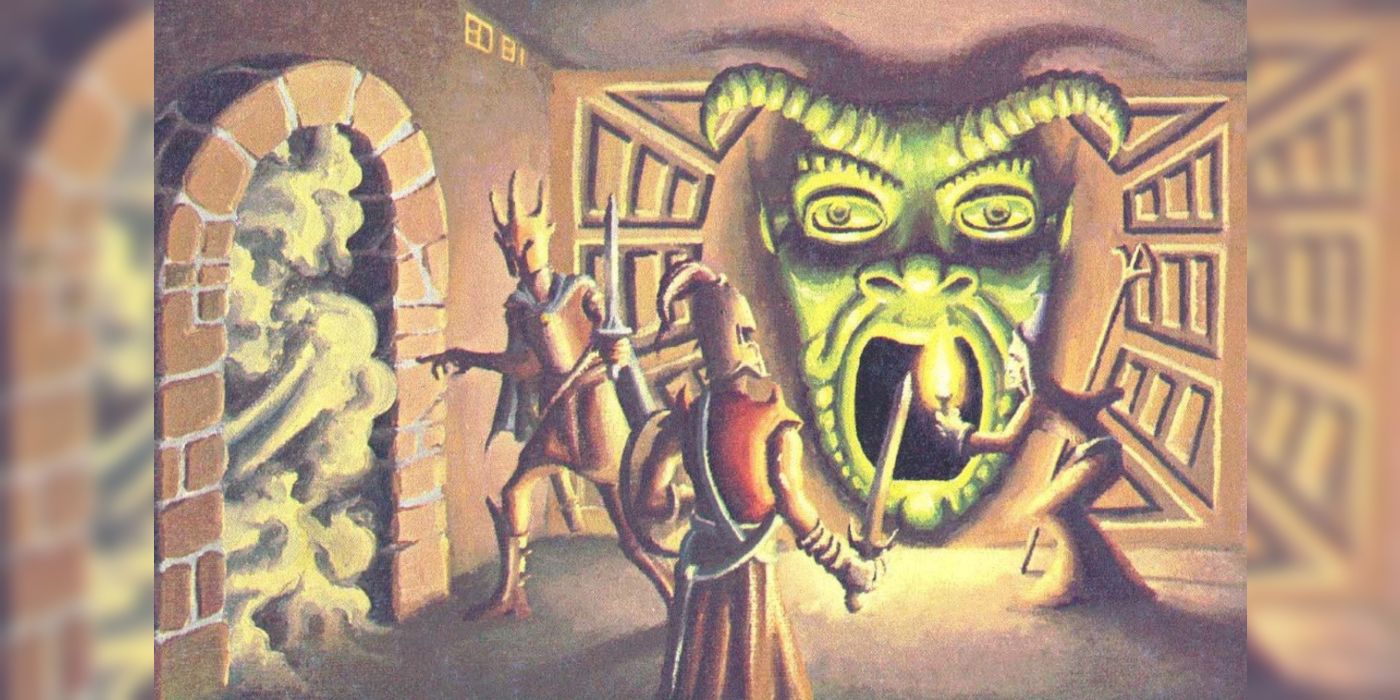
These devil faces are the symbol of Acererak's Tombs, and crawling inside one can either be a path into the next room, or activate a magical trap, such as a Sphere of Annihilation appearing beneath them, mental manipulation such as changing alignment or reducing intelligence, or a Nude Teleport. A person must be fully submerged inside the mouth for the magic to activate.
Gem Trap
A gem brimming with energy lies on the floor, usually surrounded by scorched bodies. Touching it will grant the person's any wish, but once the wish is granted the gem will release an explosion of energy powerful enough to kill most adventurers.
Teleportation Circles
Stepping into these circles will transport a person to a random location, including but not limited to one of the Nine Hells, the Abyssal Plane, or even the “real world” in Victorian England or modern day California.
Necromancers
In Return to Tomb of Horrors, Tomb of Horrors Second Edition, and Fourth Edition, Acererak's Tomb is surrounded and populated by Necromancers who worship him and attack any trespassers.
Gargoyles
Stone gargoyles capable of flight. The one in ToA will spray sleeping gas before activating the Stone Juggernaut. In a previous room, there is a Flesh Golem attached to a chain that when killed, will activate a mechanism that transforms the gargoyle statues into living beings.
Wights
Wights have the ability to reduce a character's maximum HP, and the specific Wights in Tomb of Annihilation/Tomb of the Nine Gods have the Polymorph spell which transforms people into frogs.
Withers

Acererak's personal servant who is tasked with keeping his Tombs operative. He carries a swarm of disembodied hands that travel through the Tomb and reactivate all traps and sew any killed Flesh Golems back together. He uses a Wand of Secrets, which reveals all the traps and secret paths in the Tomb, allowing him to travel around them unharmed.
Belchorzh the Unseen

(See what I did there? That's not your browser glitching, I did a funny)
Belchorzh is a Beholder, who Acererak turned invisible with a 9th Level Wish Spell. Adventurers cannot use See Invisibility or True Sight to see it.
Its eye beams fire Ray of Fear, Ray of Sickness, Ray of Frost, and Paralyzing Ray.
Its central eye on its body projects a cone of Anti-magic which dispells all magic within it.
Siren Room
A Siren surrounded by mist that reduces intelligence to 1, meaning the affected person cannot function beyond basic instincts or comprehend language. The Siren can Charm others into walking through the mist, though simply asking the Siren to leave the room will allow her to follow them.
Flesh Golems
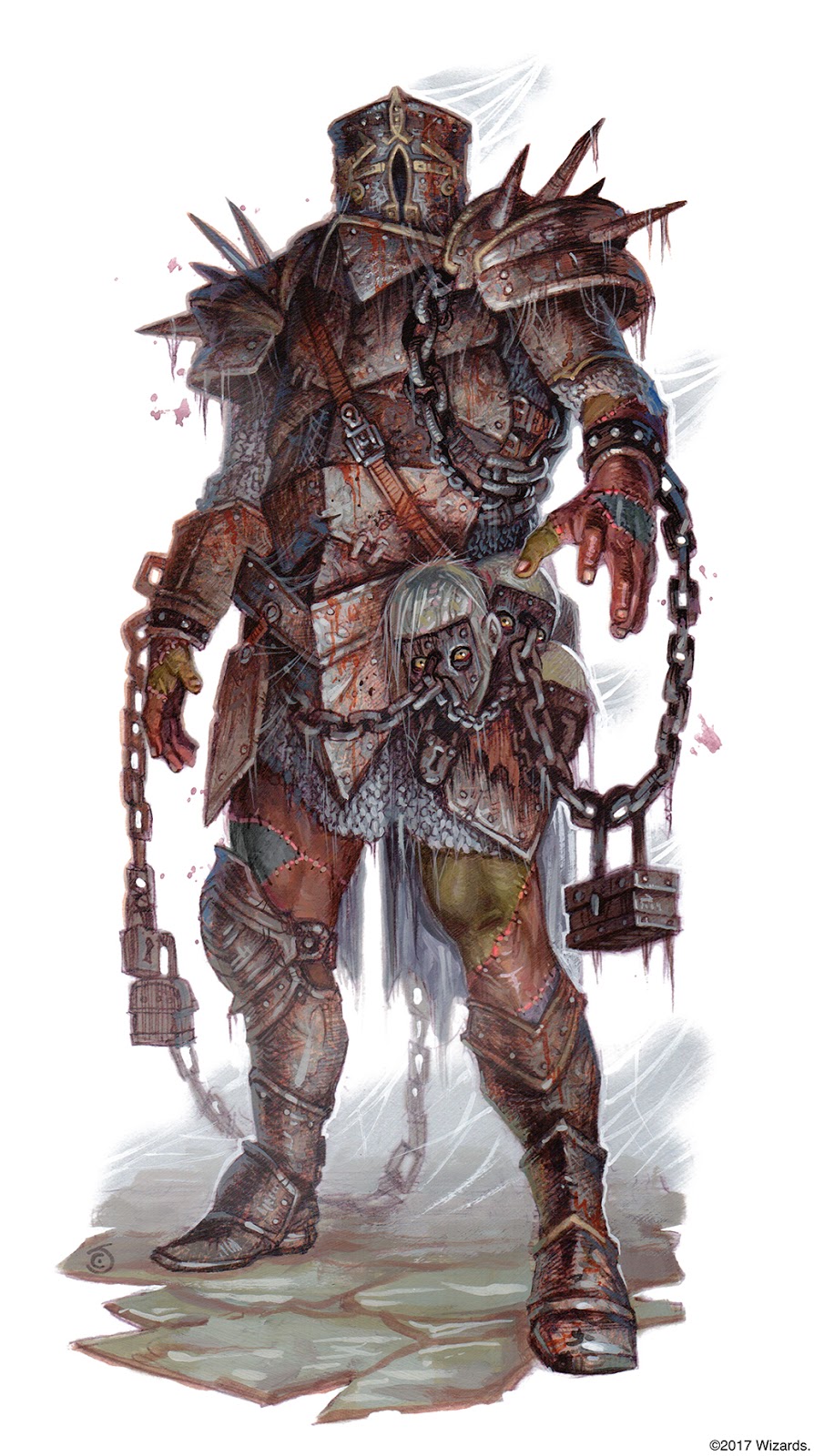
Undead servants made from the flesh of previous adventurers who died in his Tombs. Will prevent heroes from resting inside the Tombs, and assist in reconstruction and maintenance of their mechanisms.
Efreeti
A being adapted from Middle Eastern cultures, Efreeti or Ifrit are powerful, genie-like beings from the Elemental Plane of Fire that resemble Devils. The one that appears in Acereak’s Tombs will attack the player characters if they damage, move, or take any treasure, but can also be convinced to join the party temporarily and will grant wishes.
Otyugh
A tentacle monster that feeds on waste, will attempt to consume any living matter.
Aboleth
An ancient, gargantuan aquatic being with telepathic abilities. It can send telepathic messages to the characters, sounding like a young child to lure them in. Spellcasters attempting to skip forward through Acererak’s Tombs have a chance of appearing in its tank.
Undead T-Rex

The Forsaken One/Soulmonger
The Forsaken One is an Atropol, an undead infant god Acererak feeds with a device known as the Soulmonger. The side effect of this process creates a phenomenon known as the Death Curse, which spreads from Chult all the way to the Sword Coast, a similar distance to that between Australia and Europe. The Death Curse prevents resurrection, and causes anyone who has previously resurrected to slowly wither away and die. After death, the soul is sucked into the Soulmonger and fed to the Forsaken One. When nurtured to maturity, The Forsaken One becomes a planetary threat, transforming the planet of Toril into an undead wasteland. This is a process that can take months.
Sewn Sisters

Night Hags tasked with tending to The Forsaken One and raising it to maturity. They will attack anyone attempting to approach the Soulmonger or the Atropol. They have resistance to non-magical damage and can shapeshift, cast the Sleep Spell and travel through the Ethereal Plane, effectively becoming intangible.
Feats and Scaling
Due to being an Archlich, Acererak is comparable to the Red Wizard leader Szass Tamm, who performed the ritual spell known as the Beckoning Death, transforming most of the country of Thay and nearly all of its inhabitants into undead.
Scales to Gale's Netherese Orb from Baldur's Gate 3, which was capable of “leveling Waterdeep”, a large city.
Scales to the Aasimar Dame Aayland, who dispelled a shadow curse over a country-sized region.
Acererak killed The Nine Trickster Gods of Omu, and Uptau, the creator of the continent of Chult.
Upon activation of the Soulmonger, a Death Curse will take hold which has a multicontinental range (see above sections).
The Soulmonger also affects all other Lich Phylactories, forcing the Red Wizards to intervene in Tomb of Anihillation, exemplifying how big of a threat he is in that adventure that other established villains are caught in this arcane cataclysm as an indirect result of his actions.
If Acererak is successful in defeating the heroes in Tomb of Annihilation, he causes the seas to dry up, a feat that would be multicontinental at the least, if not Moon level.
Speed
Again, Acererak is surprisingly fast and agile despite being basically a mummy in his physical body.
High-level DnD characters have the capabilities of supersonic speed, and can dodge electrical bolts, making them hypersonic. (Dex saves against Lightning Bolt)
Acererak also has Legendary Actions and Lair Actions, meaning he can make actions during someone else's turn. Yes, this is a game mechanic, but in-universe a turn or round of combat takes place within a six-second period in which the characters choose what actions to take within that period of time. Being able to take up to three more actions per round than player characters means that Acererak is faster than most characters, and can also react to spells and character movements.
Weaknesses

You've probably noticed that I've been using terms like “saves” and “resistance”.
That's because of the “Saving Throw” mechanic of DnD, meaning a player can roll dice to see if their character resists the effects of a spell or ability. I've also been throwing around the term “Spell Level”, which is another mechanic that in short denotes the power of the spell, and the spellcaster would need to be at a significant stage of power in order to use or counter a spell of that level.
When you factor in other fictions, this would also apply, but you would have to go by the feats those characters are capable of because “8d6 force damage” doesn't quite translate well to other mediums.
Acererak also has a Phylactory, a magical device to house his soul and consciousness to control his body and any undead or simulacrums remotely. If destroyed, or if his opponent has sufficient soul hax they can prevent him from using his Phylactory to create a new physical form, killing him permanently.
Most of his stronger spells also require verbal components, meaning he has to speak to cast them. If silenced or otherwise made unable to speak, nearly half of his spells would be disabled.
Also, Acererak has what I like to call a “Bowser Complex”, where he always includes some way for the heroes to progress forward or succeed if they can figure it out. One would only need to understand Acererak's ironic sense of humor that plays on the expectations of adventurers, such as activating traps instead of avoiding them to reveal the path forward, or calling out to a Siren instead of the other way around. He can't help himself but to leave behind cryptic riddles that give hints on how to solve his puzzles and avoid his traps. Some of his servants also hate Acererak and can be convinced by adventurers to join up against him.
Recap

+Multicontinental and hypersonic
+Necromancy allowing for multiple avenues of summoning or creating undead servants
+Can revive with his Phylactory which he keeps guarded and hidden
+Rarely leaves his lairs, making it an uphill battle for heroes to reach him
+Can BFR
+Can prevent regeneration
+Can prevent resurrection and activate the Death Curse with the Soulmonger
+The Forsaken One can become planet level if given enough prep time (months)
+Can remove equipment with teleportation and disable magical weapons and abilities with Belchorz's Anti-magic, or by other means
+Can turn anyone dead or undead into his allies, provided the Necromancy to animate them isn't stronger than his own.
+Resistant to most types of damage and usually has two physical forms, his Similucrum and his original skull, the former of which he can reform with his Phylactory.
+Can counter most magical abilities
+Power Word Kill can instantly kill most “squishies”, or builds with low health.
+Invented trolling 20 years before the internet started
+Never got beat up by some teenage nerds in the 80s, unlike that fraud Vecna
-Bowser Syndrome, leaves hints on how to avoid traps and monsters, always includes a way for heroes to succeed
-A number of his monsters can be convinced to join the heroes
-Characters with high survivability and vitality can survive Power Word Kill
-A Silence spell will disable his more powerful magic, or some other means of preventing speech.
-Most of his more dangerous threats come from prep, though he is formidable enough on his own.
-His resurrection and physical bodies can be overpowered with sufficient enough soul hax
-Was given the unfortunate nickname “Asscrack” by the Arcane Arcade crew
Suggested Opponents
The Lich King (Adventure Time)
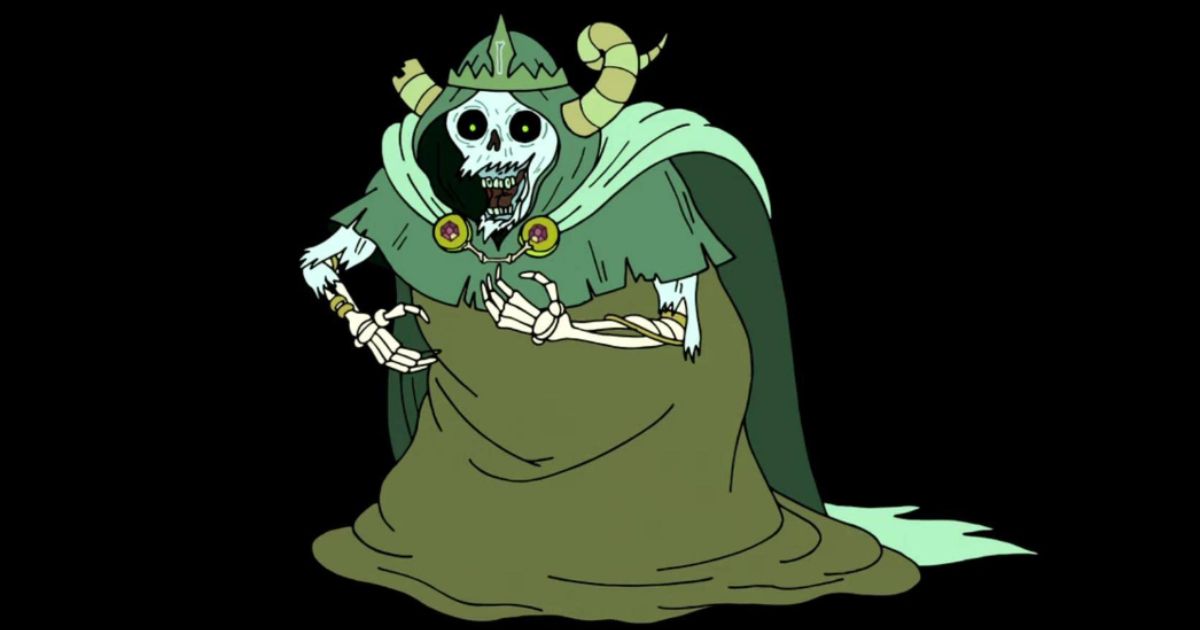
This is probably the most thematically appropriate matchup, since Pendleton Ward, the creator of Adventure Time, also wrote and helped work on Tomb of Annihilation, the modern revival of Acererak and spiritual successor/sequel to Tomb of Horrors. Lich King, aka simply The Lich, is a reoccurring villain in AT. He is MUCH older than Acererak, predating all life, and wishes to end it. He was at the epicenter of the Chicxulub Impact that killed the dinosaurs and survived a nuclear war.
He has similar hax, including Necromancy, dimensional manipulation and transportation, mental and psychic manipulation, weather manipulation, and electrokinesis.
AT has some planetary scaling, but Acererak could level the playing field if the fully matured Forsaken One is allowed.
The only problem with this matchup is it's potentially a stomp as you could argue The Lich survived the Big Bang, though this could have been when he was a primordial presence before he was given physical form.
Dracula (Castlevania)
Is also known to wait in his lair, filled with monsters and deadly traps. Vampires actually fit right in to the Forgotten Realms setting, with the concept of Curse of Strahd basically being “What if Bram Stoker’s Dracula took place in a high fantasy universe”. He has similar abilities and feats, though can be considered sub-galactic if the black hole that appears in some of his boss fights is a legitimate singularity.
Sauron(LotR)

It is impossible not to draw parallels between fantasy RPGs and LotR, as most modern depictions of orcs, goblins, elves and the like are based on Tolkien's interpretations of Fey creatures from Scandinavian and Germanic-European folklore.
Acererak is a lich, a creature adapted from said folklore, and his dad is a Baalor, literally just a Tolkien Balrog in everything but name to avoid copyright.
Sauron also famously waits at his home turf with plentiful traps, enemies, difficult terrain and obstacles, as the saying goes “One does not simply walk into Mordor.”
The two have similar powersets and stats, though Acererak may have better hax and can BFR with his teleportation traps and Planeshift. He would also likely recognize the Ring of Power as similar to a Phylactory, and would be able to resist its influence.
Imhotep (The Mummy, 1999)
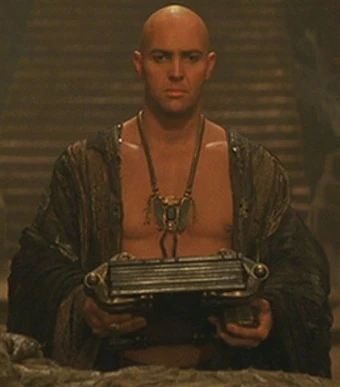
Imhotep is the main villain of the Mummy revival from 1999. The Mummy in the 1932 movie is also Imhotep, but that’s an entirely different continuity so the inclusion of both would be up for debate, since Acererak throughout all Editions of DnD is basically the same guy. Like Acererak, Imhotep is an undead being intent on spreading death and chaos throughout the world of the living, and through the Book of the Dead and Hom Dai curse, also controls a number of undead servants, and operates from within his own Tomb at the necropolis of Hamunaptra.
He commands the Plagues of Egypt, capable of life-wiping cattle and first-born throughout Egypt, and summoning a hail of fire to cause destruction across similar areas.
Link
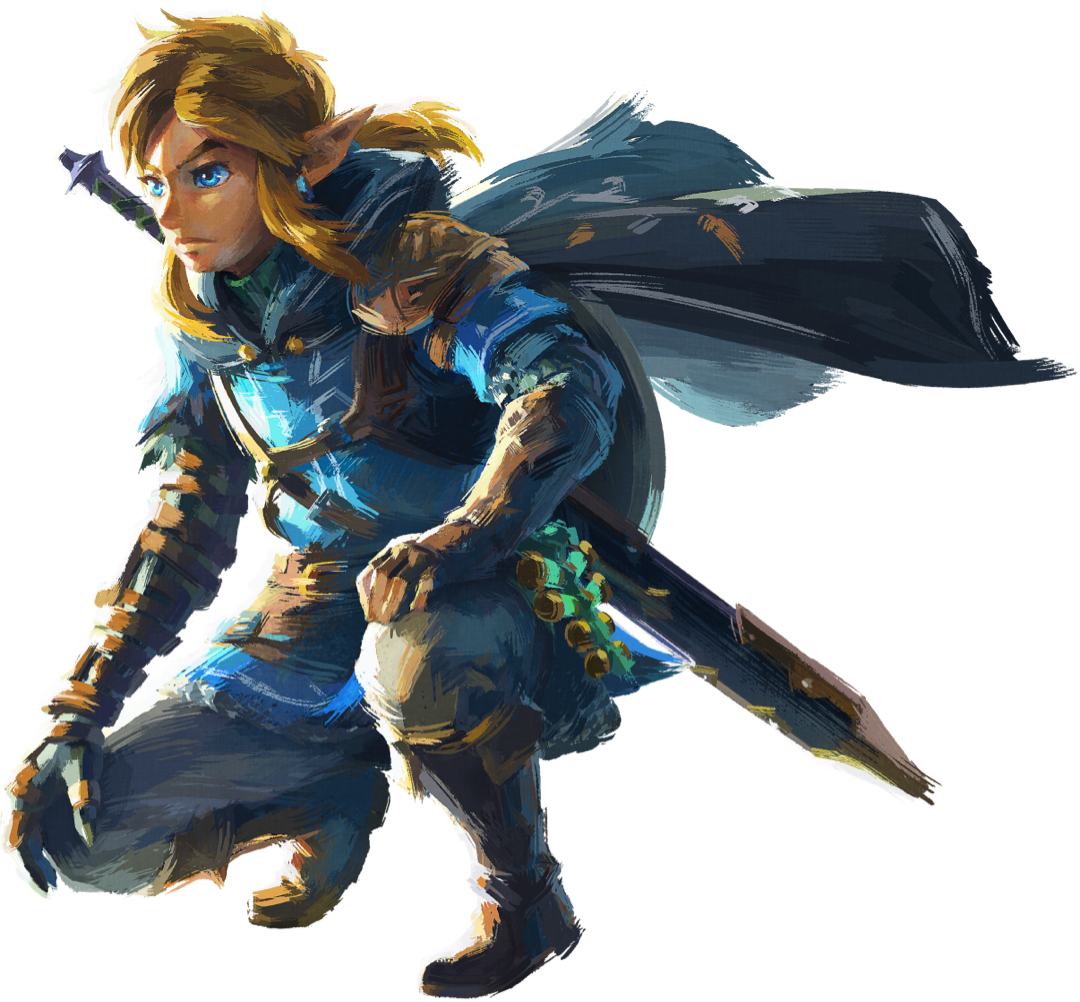
Link is the amalgamation of the classic fantasy Western hero, re-imagined through an Eastern lense, repurposed to fit the medium of video games, and reinterpreted for each console generation.
Arguably, he is the definitive Dungeon Crawler, since the Legend of Zelda takes that fantasy trope and adapts it into a video game setting. Link has plenty of experience avoiding deadly traps and fighting monsters, challenging his physical and mental capabilities in ways strikingly similar to Tabletop RPGs.
This is the most even matchup I've listed due to Link's stats and hax resistances, depending on the incarnation (though a lot of that tends to overlap thanks to recurring equipment from previous games appearing in modern games)
Also, the opening segment to Tears of the Kingdom is basically Link meeting a DnD lich, down to getting his max HP reduced and losing his best magic weapons:
https://youtu.be/qRbNYmwigXI?si=Qgm5kmDSPY5QdO9A
However, most of his power and magical abilities come from his equipment, meaning he would be most negatively impacted by a Nude Teleport.
…What? I'm not blushing, you're blushing.
Conclusion
I always enjoy writing these, particularly whenever I can freshen it up with a different concept or twist. People tend to gravitate towards things like shows or video games for powerscaling, which is understandable due to them being visual media thus making their feats easy to quantify. Non-visual media has a tendency to be more arbitrary due to having no visual representation other than text or the like, which tends to turn people away from it, or leave enough interpretation to make some favorable assumptions. So from this, there's a sort of over-correction, where scalers seem too afraid to address them. However, I would encourage them to step outside their comfort zone and attempt to analyze these fictions as pragmatically as possible, as this was a lot of fun and I find the end result to be satisfying and highly rewarding.
So I hope you found this educational, or at the least bit entertaining, and if this inspires you to do the same then that means the world to me.
I am Hero's Shade, and thank you for reading.
