Friday, May 11, 2018

Zelda Theory: Solving the Windmill Paradox (How Time Travel works in the Legend of Zelda)


Welcome back, everyone! I am Hero's Shade, and this time around I have decided to take on a particular mystery that has perplexed fans of Zelda ever since the release of Ocarina of Time back in 1998 (seriously, 20 years ago? God, I feel old), what is known as the Windmill Paradox, aka the Song of Storms Paradox or Music Man Paradox.


For those of you who are unfamiliar with the game, what have you been doing with your life? there is a cheerful man with a music box inside the windmill at Kakariko Village. After you pull out the Master Sword and become an adult, you find the music man furiously cranking his music box, complaining about a boy seven years ago who played a song and messed up the windmill. He plays that song, you play it back, and you memorize the Song of Storms. Then, in order to progress through the game, you must play it again in the past in order to make the windmill spin rapidly and drain the well. He hears the song, and is the same song he complains about in the future and teaches to you.

But... if Link played the song in the past after he learned it from the music man in the future, who in the past learned it from Link...and...


Alright, so it is likely that Nintendo's developers just put this in the game as a throwaway gag to be joked about later on. But that answer is simply unsatisfactory to me. After all, what kind of nerdy internet theorist would I be if I didn't analyze and over-complicate something that isn't meant to be given that much thought? 

In all seriousness, jokes and Easter eggs like this can become part of a series' official lore. For example, the infamous Bat Shark Repellent has become canonically an item stored in Batman and Robin's arsenal, and numerous quotes and one-shot references from Star Wars: A New Hope have become the building blocks for three prequels and entire episodes and seasons of the Clone Wars cartoons, not to mention those cartoons themselves.

So, from a lore perspective, where did the Song of Storms come from in the first place, and how did Link learn it? To answer that, we'll have to explore how time travel works in the Zelda series, so buckle up. It's going to get more complicated from here.


To start off, I will explain some of the various methods of time travel and how they differentiate  from one another.

First, we have the Ocarina of Time, which is capable of performing various magical spells via playing the right notes on it. For instance we have songs that warp Link to various locations and the aforementioned Song of Storms, which is capable of summoning strong wind, heavy rain, and lightning, although the primary function is time manipulation.

You may want to take note on how I used the phrase 'time manipulation' instead of 'time travel'. I'll get to the finer details of the latter later on, but let's say for instance Link plays the Sun's Song. The Sun's Song, as the name suggests, causes sunrise or sunset. Contrary to what... certain... websites and wikis may have you believe, this melody does not actually affect the gravitational cycles of the Earth or moon, Link is actually accelerating time to the next interval that would begin night or day. This is proven by the fact that the guard in front of Kakariko Village who keeps track of time will indicate that time has passed whenever you use the song, and while Biggoron is crafting you the two-handed weapon Biggoron's Sword you must wait a few days for him to complete it, but you can just play the Sun's Song a few times to get it right away. This is also very similar to how the Song of Double Time works in Majora's Mask.

Keep that in mind, as this is different from how he time travels works when pulling out or replacing the Master Sword from its pedestal.

There are those who use the timeline split in OoT as a reference to indicate that Link creates an alternate timeline, as well as an alternate timeline version of himself every time he withdraws or removes the Master Sword. I'm sorry to say, but they've got it all wrong.


When the Hero of Time pulled out the Master Sword, it essentially judged his worthiness and determined he would not be ready until he was older (Though Wind Waker Link wields it with no problem. I guess it didn't want to repeat the same mistake it made here by leaving a portal open and letting Ganon get the Triforce of Power. Hindsight is 20/20.), therefore Link's Spirit was sealed in the Chamber of Sages for seven years. Alternatively, Link can replace the Master Sword back in the pedestal to return his spirit seven years back into his child body.

There is no new version of Link or any new timeline being created here, it's the same Link being put into a magical coma, with his spirit and consciousness traveling back and forth between his child and adult bodies in the past and future. Now, this by no means contradicts the timeline for a multitude of reasons, but that's a whole other can of worms I don't want to open right now.

The point here I'm trying to make is that when Link transfers his spirit into his future body, everything he did as a child has already happened, since this is all the same time continuity. This is true for the Spirit Temple, where Link has to go back in time to retrieve the Silver Gauntlets and return as an adult in order to save Nabooru and complete the dungeon. In the future, you will also find the unbeatable Running Man in the tent in front of the bridge to Gerudo Valley, who you gave the Bunny Hood years ago, as well as the Skull Kid in the Lost Woods who you find playing Saria's Song that you taught to him as a child. This concept is also seen again in Twilight Princess, where you find an old opened chest. Then, you travel to the past and open it. This means in the present time, Link found it open because he already opened it in the past.

What this means is that when Link is in the future, he already played the Song of Storms and messed up the windmill, even though he hadn't traveled back and done it yet from his perspective. But doesn't that leave the question of who taught Link the song unanswered? No, actually. He learned it from the music man.

If you pay close attention to him in the past, he says that he wants to write a song inspired by the windmill, going around and around and around. Naturally, Link has a talent for imitating songs he hears. We've seen him do it before with Malon's humming and Sheik's Harp. And typically, music boxes only play one song, unless programmed to play something else.

So, there we have it! Link simply copied the notes from the music man, and the magical properties of the OoT caused it to summon a storm. And we're done! Good night, everybody!


...


Oh dear.

See, the sequel complicates things even further. Majora's Mask takes places some time after Link defeated Ganondorf and Zelda returns him to his own time to have a childhood and grow up naturally. As a child, Link ventures to find Navi and comes across the land of Termina.

A bunch of other stuff happened, but while there, he learned the Song of Storms from Flat, one of the royal Composer Brothers. Now... how could it be possible that the music man and Flat wrote the Song of Storms, and that Link only learned it after he went to Termina? Not only that, but there is also a pair of Composer Brothers that serve the Hyrule family and happen to be named Flat and Sharp, and look exactly the same.

In regards to Link learning the Song of Storms from Flat, remember, everything Link does in the past already happened seven years ago from the perspective of future Link, so child Link would still have known the Song of Storms from Flat and played it at the windmill.

It's an existing fan theory, and certainly a fascinating one. However, that doesn't answer any of the other burning questions. And to do that, we need to talk about PARALLEL UNIVERSES!


Yes, as if time travel shenanigans wasn't enough, we now can add parallel universes into this clusterfuck.

It is stated in several guidebooks that Termina is a world parallel to Hyrule, similar to the Dark World, the Twilight Realm, and Lorule. This is how identical or identical-looking characters can exist in parallel to their OoT counterparts and some of the same things can exist in both worlds, even with different origins. (The real world explanation is that the developers only had a year to finish the game and had to resort to using a lot of the same character models to cut down on time.)

So, that means that one of three things is happening here:

A, Link really did copy it from the music man in the first place and the version by the Composer Brothers is parallel to the OoT counterpart.

B, Either Link or the music man read the music notes from Sharp and Flat's gravestones in the Kakariko Graveyard for inspiration (the Sun's Song and the Song of Storms to sound very similar)

Or C, Link learned it in Termina, returned to Hyrule, and played it in the windmill, "closing the time loop", so to speak.


Now, I'll admit these theories are by no means flawless. I've mentioned before that at the end of Ocarina of Time, Zelda sends Link back to the past. And after that, Link sets out on his adventure in Majora's Mask. So... this presents another paradox.

How can Link complete his journey in Ocarina of Time if child Link doesn't learn it until the events of Majora's Mask, after Link defeated Ganondorf and left the Master Sword in the Temple of Time? And Link never using the Master Sword to travel back to his future body again (that we know of, at least) and growing up naturally after that point is what created the timeline split into the child and adult timelines (because the future Link that emerged from the Chamber of Sages after seven years technically still existed), so how could he play it in front of the music man to teach it to his future self if it's after the time split?

Well, the fact of the matter is that the music man in the future still plays it, we just have a little more insight to it now thanks to MM and other lore. Perhaps MM has nothing to do with it, in fact I doubt the idea that the sequel would give some explanation crossed their minds, since they didn't even know they'd be making a direct sequel until after the fact. But that's nothing a little retroactive continuity wouldn't fix, and all it would really take is one little reference or interview statement to make it canon.

But alas, for now, we can only speculate. It truly is a song that goes around and around and around.

Now if you'll excuse me, I need to heal my brain's sorrow's.


I am Hero's Shade, and I'll see you all next time.

Thursday, May 3, 2018

VS Discussion: The Anti-Debaters


Hello everyone, Hero's Shade here! Today I thought I'd whip up a quick blog page to talk about something that irks me about the VS community, and is unfortunately becoming largely more prominent lately. Yes, I know, VS debating is terrible and water is wet, news at 11.

Have you ever been to a freind's house and played a game with them, and said friend has their own set of house rules that put you at an obvious disadvantage? Well, if you can't recall being in a situation like that, let's say you're playing chess with someone. You begin the game and attempt to move a pawn forward two spaces, but your opponent tells you that because of their house rules you can only move pawns one space at the beginning of your turn. He later revises this rule when he does just that, saying you can only do it once per game. Later, you move your pawn to his side of the board to make it a queen, which would put his king in check, and he has no way of eliminating that pawn. He pulls the house rules card on you yet again saying that you can't make your pawn a queen, only a knight or a rook, and those just so happen to be the two pieces that can't put the king in check on that particular turn. At this point, it becomes clear that this player will just bend the rules in any way that would benefit him and prevent him from losing, even though it is clear that you'd be the winner in this scenario if the game was being played normally.

Now, I'm not going to knock anyone for playing games by their own house rules as long as they are discussed beforehand, but hopefully I made my analogy clear. The rule-changer in this scenario is preventing any situation where the other player would be winning by meta-gaming and cheating himself out of losing rather than simply resorting to the options already available to him and being a good sport. Or how about this, playing a fighting game where one player is using hacks and cheats to win against another player who is playing fairly. This doesn't prove that you're any more skilled than the other player, all it proves is that you can cheat and deny victory from other people who deserve it. In fact, there some situations where it hasn't worked, but that's beside the point.

It makes more sense to use a universal set of rules that anyone can work off of on hand rather than make your own and expect everyone else to follow the rules you made, yes? And that brings us back to VS debating. Debating in general is a logical exorcise. It is best done after extensive research (and I don't just mean spending ten minutes skimming wikis lmao) to compare the facts you've compiled with someone else, as well as-to an extent- the rhetoric used to present information. It is a very informative and enriching experience for those who know what they're doing.


Unfortunately, there are those who will essentially become Obi-Wan ("I have the High Ground, DON'T TRY IT!") and attempt to avoid or hand-wave information and rhetoric. I refer to these people as "Anti-debaters", because they essentially defeat the whole purpose of debating as a logical exorcise, and because they create a lot of the negative stereotypes associated with internet VS debating, which I'm sorry to say are accurate, more often than not. However, I will make an attempt to inform people of these Anti-debating tactics, as well as to purge  educate  also inform those who use them, so hopefully less people will resort to them and less people will be turned off and discouraged by this hobby.


"VS is just opinions anyway"


This mentality is one of main reasons I decided to write this blog, because it's one of the best examples of Anti-debating. People who say this during debates likely only say this because actual evidence presented to them goes against their pre-conceived notions of a character or series, or resort to this as a last ditch effort to declare victory in an argument.

This is also counter-intuitive and circular logic, because these people will often present a character as the irrefutable, objective winner, and when they run out of arguments (if any) will claim that it is their opinion that this character will win. If it's an opinion, by definition, it is neither irrefutable nor objective. Which... means it's still open for debate. Hypocrite that you are! Will you fight? Or will you perish like a dog?

Now, a lot of people who say that debating is opinion-based take issue with calculations. Which is fair enough, there are some calculations that can be revised or refuted. But saying all calcs are wrong or that calcs can't be applied to fiction at all is just silly. Yes, we are talking about fictional worlds that may or may not follow the same rules as ours, but most fictional universes have the same universal constants as ours, like gravity. And the very few that don't are the exception rather than the rule. For example, you won't just see people floating around when you're catching up on the Walking Dead, the fact that there's fictional elements like zombies doesn't change the fact that physics are still a thing in their world. Therefore, it only makes sense that they should also follow the same general laws of physics (which you can apply math to because anything that exerts force can be measured in kinetic energy).

Says who? This guy named Occam. He makes great razors. 

"Occam's razor (or Ockham's razor) is a principle from philosophy. Suppose there exist two explanations for an occurrence. In this case the simpler one is usually better. Another way of saying it is that the more assumptions you have to make, the more unlikely an explanation is."

" Occam's razor (also Ockham's razor or Ocham's razor; Latin: lex parsimoniae "law of parsimony") is the problem-solving principle that, when presented with competing hypothetical answers to a problem, one should select the one that makes the fewest assumptions."

My point is that there are things in fiction that you legitimately cannot argue against. Take the Greek legend The Twelve Labors of Hercules for example. The feats he performs in the story have a huge impact on the world around him, and are a driving force for the narrative in general. They happened. Your argument is invalid. The same can be said about most of fiction, like a hero defeating a villain, or a character performing a certain feat triggering a specific event to happen (say, causing a volcano to explode, resulting in a major conflict). Now, when it comes to varying versions of the story, such as if Hercules fought the Hydra alone or with his cousin or nephew, those things are subjective. But more often than not it won't be a deciding factor and there are plenty more examples and pieces of evidence that are much more blatant and concise.

The Stonewallers


This one is pretty self-explanatory, so expect this section to be short. 
These are the people who will have a list of reasons, if not one reason, why they think a character should win, and will never back down from those points or present any new information despite those reasons being repeatedly contested. Said arguments against those points will either be ignored or argued around in circles and/or buried in a sea of comments, only for the stonewaller to continue to present their points as the clincher to newcomers and lurkers. Stonewallers will also use those same points to go against anything the debaters bringing in actual evidence have to say.

Now, it is true that there are times where the information you would present is accurate and the refutations against it are wrong (for example let's say you are arguing something Mario related and somebody argues against your points using an example from the US version SMB2, which is in a dream) , and you often have to repeat yourself. But I'm talking about instances where say, people will claim Saitama will always beat anyone with one punch (I'll get to NLFs later) despite being presented examples from his own series where it took more than one punch to beat someone, and will continue to insist the idea that he always beats enemies with one punch despite being proven wrong multiple times.

This is not debating. This is the age-old children's playground argument of "nuh-uh, is too is too!"


The Hive Minds/The Yes Men


Again, self-explanatory, and you can easily see the issue with this simply by watching the video above. Hive minds and yes men are two different issues, but they do go hand in hand. 
I've been in plenty of situations where a mod on a VS site will just agree with whatever the last thing was that was posted, even if said posts are on opposing sides of the argument. Said mods would often be in charge of whatever was posted on the wiki and main page, which is concerning. There is essentially no debate, and nobody disagrees with anything, aside from outsiders who don't think the same way they do. So you have proverbial Superintendents letting metaphorical houses burn down because they were convinced the Arora Borealis is in the kitchen, despite the fact that those hamburgers are obviously grilled.


Proof by Example

There are plenty of people out there who, rather than going by generally accepted methods like feats, go by arbitrary views or concepts when it comes to certain characters and works of fiction, and Proof by Example Fallacy aka No Limits Fallacy is certainly a by-product of that.
For instance, I have argued with people (who shall remain unnamed, but if you were there you know who they are and I'm sorry for triggering the PTSD flashbacks) who believed that Psycho Mantis could convince any character to kill themselves, or that Freddy Kruegar with the Power Glove had control over any video game character, like he could just snap his fingers and kill Kratos or Asura.

And the biggest problem with this is that they believe that this is the only way to look at fictional characters, and that feats are just secondary, or that they don't matter at all. They believe these subjective concepts are the correct and accurate way and that using numbers, calcs, feats and actual examples from the series is nonsensical and silly.

Going back to what I started this with, these people essentially expect you to drop everything you knew about the characters and debating in general and perform the same mental gymnastics with them.


Me and my friends have this inside joke where you could break these peoples' minds by asking them if Ganondorf could survive a punch from Saitama, and just watch the beauty unfold.

Oh wait, silly me. Whoever wins is whichever character they're a bigger fan of.


Toxic Fanbases


Now, I will openly admit that I am an elitist. I've been doing this for about 5+ years now and have lurked and participated in various VS communities, read tons of respect threads, read plenty of comics, watched tons of TV shows (yeah I know, watching TV, so difficult), as well as written many blogs on and researched many characters. I like to think I know what I'm doing, and I believe there's nothing wrong with being proud of what you do. However, there is a line to be drawn. This should go without saying, but if you tell someone to go kill themselves or just in general act like an asshole or condescend someone the entire time they just want to have a rational conversation with you, chances are they're not going to want to hear your points. This also works conversely. Don't dismiss someone's arguments just because you think they're an elitist, try to hear them out and if they're being toxic just let the mods handle it. Just be respectful to each other. Because at that point there's no actual debate taking place and it devolves to a pissing contest. You're arguing about fake characters on the internet for fuck sake, there's no need to make it personal.


The Posers
 
That guy. You know the one. That guy who only knows memes or surface knowledge about a character and acts like an expert. That guy.

That guy who thinks Aquaman loses every fight because of Robot Chicken, yet had they actually bothered to look even a bit deeper into the character they'd know that that portrayal of the character is exclusively from a cartoon that came out 50+ years ago, and that Aquaman actually has superhuman strength, speed, and agility, can summon tidal waves, and that communicating telepathically with fish isn't a "dumb power" when you can use it to summon sharks and giant squids, not to mention prehistoric creatures and mythical figures like the Kraken.


That guy who thinks Deadpool has metafictional manipulation and can beat anyone because he's immortal, yet in the recent comics he had his deathless curse taken away, the comics clearly establish that healing factor has a limit, and Deadpool Kills the Marvel Universe is a non-canon elseworld that exists solely for the purpose of DP killing everyone, thus them being horrendously nerfed.

That guy will also continue to act like an expert despite being shut down several times by people who actually know what they're talking about.

Don't be that guy.
Conclusion

Well then, I think that just about wraps things up. Let me know if you have anything you'd like me to add or take issue with anything I said here, and I will gladly discuss with you.
I am Hero's Shade, and thanks for reading!

Tuesday, March 20, 2018

The Chaotically Coy Ki Condescending Kitty-Cat God: Beerus the Destroyer!


Hello, everyone! I know it's been a while since my last analysis blog, but now I'm back! Yeah, I know, I say that a lot, don't I? Well, think of it as me going into a long slumber and waking up every now and then to grace you with my presence, which brings us to our subject matter this time around...


Background


Puts on best Kyle Hebert impression
Ah-heh-hem! 

Time and time again, Earth's strongest warriors have prevailed against those who have threatened the Earth and its inhabitants. From King Piccolo to Majiin Buu, it seemed that there was nothing out there that could stop the super-warriors known as the Z-Fighters. But the likes of Goku and Vegeta have been waiting for when a being even stronger than Buu would arrive, and diligently prepared themselves for when that day would come.

But little did they know, that being would be far more powerful than anything that appeared before, even the strongest beings like Super Vegito paled in comparison to his enormous power. Only the arrival of the Super Saiyan God awakened from within Goku proved to be a worthy opponent for this being, and even still,Goku had lost. All of the planet's finest warriors were effortlessly cast aside by this seemingly unstoppable force.

"This is what happens when mortals don't share their pudding!"
This being was Lord Beerus, the God of Destruction, who had been slumbering in the far reaches of the cosmos for many years.


However, while he did challenge the Z-Fighters and won't hesitate to extinguish life and planets on a whim, this does not necessarily make him evil. Rather, he is a force of nature that exists to maintain the natural order.

While he does seem like a sociopath in the sense that he will destroy beings or planets over petty things such as losing a game or not liking food, or just finding them annoying in general, well... if you're at all familiar with Greek mythology, gods are petty like that. However, he does care about the well-being of his universe as a whole and will defend it against anyone who attempts to threaten it (including Goku at one point). He also seems to have a soft spot for Earth and it's inhabitants, as in the ending of Battle of Gods he blew up a small pile of rocks and joked "There, I destroyed earth" and has become friends with Bulma since she gives him food, the secret to winning any cat's love.

Beerus' design was based on an Egyptian hairless cat (called a Sphinx, no less), and in true catlike nature, enjoys little beyond eating and napping, and doesn't like being bothered when he's doing either. His likeness, role, and demeanor are also inspired by Anubis, the Egyptian God of Death (There are even Kali and Ganesh stand-ins in Dragonball Super, I'm just waiting for Buddha to show up for the Journey to the West and Monkey King references to come full circle). It is also revealed that there is an entire multiverse with more gods out there, 12 in total, and Beerus is the GoD of Universe 7, the one the Z-Fighters reside in.

Now, you may be thinking "How could a being that powerful and significant have existed all this time without anybody ever mentioning him?" Well, that's unfortunately what happens whenever some new plot point is introduced, such as when we discovered Goku was actually an alien. However, there is a legitimate explanation. The Supreme Kais made it a rule of thumb to keep his existence a secret so none of the universe's fighters would attempt to challenge Beerus or otherwise annoy him-especially Goku-, thus risking the universe. And while Vegeta did see Beerus on... Vegeta (the planet) standing over... Vegeta (the King), he didn't really know who he was or anything about him at the time, to him he was just some weird alien who threatened his father. Also, if you pay attention, there are actually subtle hints sprinkled throughout previous stories in Dragonball, suggesting that Toriyama had probably been planning his appearance for a while (but that's delving into fan theory territory). I'll get to those later in the Feats and Abilities sections.


In case you were wondering...
With the Battle of Gods and Resurrection F movies, Dragonball Super, and the manga, with all the inconsistencies between each of them, it's hard to discern what's canon and what isn't. Well technically speaking, all of them are. Akira Toriyama was responsible for the movies, and Dragonball Super is officially what happens in between all of them. Though this may create a lot of problems in terms of continuity given all three tell the story in different ways, for example Beerus was sleeping in Battle of Gods and Whis had to wake him up to remind him about the Super Saiyan God he prophecized, whereas in Super he was already awake, and other minor changes such as Bulma's birthday party on a cruise liner instead of on land, as well as a ton of various plot holes, etc. However, that doesn't really change the fact that Super is still canon with the movies and the series in general, and Toie and Toriyama simply aren't concerned with these plot holes and inconsistencies, they just want to make more Dragonball content. I know that sounds cynical, but isn't that pretty much the goal of every franchise?

That being said, I will be using all of them as reference material.

Powers and Abilities


Energy Manipulation/Godly Ki

Given he is a Dragonball character, Beerus can tap into a metaphysical energy source to augment his strength, durability, and speed as well as grant him flight and of course your obligatory energy blasts and balls. However, since he is a deity he uses something a little different from the standard Ki we've seen used in Dragonball. He uses something far more potent that sets him apart from other Ki users which prevents them from being able to sense his presence. Though it has no real name, this divine energy is referred to as "Godly Ki" by the characters. Tapping into this power is what allowed Goku and Vegeta to reach their Super Saiyan God forms.


Spheres of Destruction
I don't care if he is a low-tier character in FighterZ, he's fun as hell to play as
The Spheres of Destruction are highly volatile energy balls that Beerus can summon that act very similarly to Gotenks' Ghost Kamikaze Attack. Only instead of needing someone to touch them for them to detonate, he can command them to do so at any time, and can flick, kick, and bat them around without having to worry about them blowing up on him. He can summon them anywhere for a surprise attack on his opponent. They can also follow around and surround or bombard his enemies while he is attacking, like Vergil's Summoned Swords.


After-Image/Multiform

Beerus also has access to the After-Image, a technique that involves moving fast and leaving behind a projection of yourself to trick opponents (see Goku vs Cell) as well as the Multiform Technique, or at least something similar to it, which grants him "shadow clones", as it were, that can act independently. 


Cosmic Awareness

Gods of Destruction seem to have some degree of cosmic awareness that allows them to tell when they are being watched or sensed by other beings.


Sealing/BFR

As it turns out, Beerus was the one who sealed the Elder Kai in the Z-sword, meaning he has the ability to seal people inside objects. Whether this means he can only do so with certain objects or under certain circumstances is unclear, though considering Elder Kai was using this as an example of his power suggests that he can do it freely.

Martial Arts

It should go without saying at this point, but Beerus is also proficient in martial arts, trained by his attendant Whis. He has such skill and precision that he was able to take out the Z-Fighters with a pair of chopsticks, using joint manipulation and pressure points.


Pseudo Ultra Instinct

Throughout Super, Whis hints that Goku and Vegeta would show considerable improvement if they could remove the drawback of thinking and subconscious hesitation, they'd be considerably faster and unpredictable in battle. For instance, Hit can stop time for 0.1 second, though for someone as fast as him a millisecond means an entire world of difference. That, on top of a subconscious hesitation on the part of the saiyans, delays their reactions and impedes their fighting prowess by a considerable amount. Thankfully, there is a state of being known as Ultra Instinct used by angels such as Whis and Vados and subsequently taught to Beerus, which removes those limitations. Here is a video explaining Ultra Instinct in detail. In layman's terms, it's basically a more advanced, godly version of the Kaioken, only a bit different in philosophy, and without the drawback of wearing down on the user's body. The reason I referred to it as "Pseudo" Ultra Instinct in Beerus' case is because unlike Goku, he hasn't fully unleashed it and can only tap into it. (But Beerus is still so much faster and stronger than Goku that it almost doesn't matter, and in all fairness nobody has pushed him to the brink of death in order to completely awaken it.)


Hakai

And now onto the reason that the Supreme Kais and lesser so-called gods shit their pants at the mere mention of Beerus, and what gave him the nicknames 'Hakai-Shin' and 'Beerus the Destroyer'. True, his tremendous power is one reason to be feared, but there is one thing that will always cement his place as God of Destruction: the ability known as Hakai. Actually, it's referred to as Destruction in the English dub, but it doesn't quite cut it in terms of explaining what this actually is, also Hakai sounds way cooler. When Beerus uses Hakai, it completely erases the target not only on the physical, but also spiritual level. It's beyond the power of the Eternal Dragons, even Super Shenron (yes, that's a thing now, as ridiculous as it sounds) to revive the being or object that is erased. No afterlife, no resurrection, no reincarnation, you're just straight-up gone.

The only way to avoid the erasure is to create alternate timeline versions of yourself, but this must be done beforehand as the Hakai itself cannot be undone. 
"Gasp! You mean death has actual consequence in Dragonball now?"

Well, there are certain limitations, for example it cannot be used to destroy other gods. But beyond that, it can essentially be used on anyone or anything, even planets and ghosts. As Whis puts it, "Nothing is beyond Lord Beerus' power to destroy."


Feats

So, remember in that video where King Kai said Beerus "could destroy the universe if he felt like it"? Well, Dragonball is no stranger to hyperbole and villain boasting, but as it turns out, that's actually no exaggeration. 

Ah, the famous forum-busting punch, one scene that set the entire internet ablaze. 
As you can see here, Super Saiyan God Goku and Beerus' punch sent out ripples that shook most of the known universe. This of course would also apply to Beerus' durability.

Here, he fights Super Saiyan Blue Vegeta after he mastered the form and closed the gap between he and Goku. This was also after Vegeta destroyed the Hyperbolic Time Chamber from the inside, which, if you recall, is infinite space. Does that mean he has infinite destructive capacity? Well, clearly not since he still isn't strong enough to beat Beerus, so to avoid over-complicating things, we'll just call this a universal feat (recall that our universe is also described as infinite). Mah boi Veggie getting them mad gains, I'm so proud...


After he defeated Vegeta, he commends him for his efforts and states that if he were in another universe, he might be a worthy candidate for God of Destruction. As it turns out, he wasn't just offering Vegeta some solace, this statement tells us where he stands in comparison with the other gods, and the exhibition match with the other GoDs in the Tournement of Power preliminaries shows us that Beerus is one of the top tier gods in the Dragonball multiverse, if not the strongest. Also fitting that it would come down to a game of cat and mouse. Yeah, I see what you did there, TOIE.


Super Saiyan God Goku gets brutalized by Beerus. Given Goku's characterization in Super, I probably enjoy this scene way too much...


Has such control and precision with his power, he is able to destroy half a planet with a tap of his finger.


Toys with Super Saiyan 3 Goku.


Deflects attacks with one finger and dodges lightning.


We also have Beerus to thank for King Kai's planet being so small. At one time, it was roughly hundreds of times larger, but Beerus blew it up when he was salty about losing a game against King Kai, forcing him to rebuild from the leftover fragments. Remember what I said about gods being petty?


Is MFTL based on scaling to Whis, who carried the two to King Kai's planet from Beerus' realm (which would have to sit at the edge of the known universe, as it's further away then the Supreme Kai's planet) within 22 minutes, which would yield RIDICULOUSLY high numbers (The edge of the known universe is roughly 46.5 billion lightyears away from Earth). Now, it can be argued that this was only possible through the staff, and Whis is still Beerus' superior in terms of power and speed, however he would still have to steer around celestial objects. Not to mention, this is pretty much the only speed feat we can really use for the god tiers of the verse, anything lesser they would scale to is essentially a bit feat. And with Beerus clearly being MUUUUUCH faster than the relativistic to lightspeed Z-Fighters, it's not too much of a stretch to say Beerus is MFTL. 


Weaknesses


Beerus may be one of the top tiers in his verse, but he has one of the LAAAAAAAAAAAAAMEST drawbacks ever. because Super just had to ruin something else that was quality  
If you kill all the Supreme Kais in a universe (which is basically just Shin and the Elder Kai in Universe 7's case), that universe's God of Destruction will die as well. Meaning, yes, basically any of the Z-Fighters or villains could preemptively assassinate Beerus if they felt like it.

As said before, his Hakai ability cannot be used on other gods, and it can be avoided with potent enough time manipulation. Omniking Zen-Oh also has erasure hax that are far greater and seem to supersede his, so while extremely effective, it's not the be-all-end-all.

Beerus also may be immortal, but it's more of a "lived for billions of years and continue to" immortality rather than "can't die" immortality. He can be killed, provided you're strong enough or have potent enough hax like the Omniking.

Intangibles-wise, Beerus is also extremely petty and ill-tempered, and thusly can be baited into a combat scenario.


Summary

Advantages
  • Universal+ Destructive Capacity and Durability
  • MFTL
  • Billions of years of experience
  • Martial arts training from Whis, the fastest and most powerful being in Universe 7
  • Godly Ki
  • Spheres of Destruction
  • Afterimage and Multiform
  • BFR
  • Paralysis
  • Erasure Hax
  • His break-dancing skills are unrivaled

Disadvantages

  • Can be killed by killing the Supreme Kais (though it likely won't be applied in a combat scenario)
  • Hakai has some limitations
  • Ill-tempered and petty, has no patience
  • No match for Gohan Blanco  


Potential Opponents
 Galactus

Thematic, and even! Both are universal and MFTL. Both are purple, not technically evil but have threatened the Earth on multiple occasions forcing its heroes to fight them off, and both are cosmic beings that stand above most mortals in their respective universes. It would also be fun to see how their personalities play off each other, for example Galactus eating a planet and Beerus getting mad because it had one of his favorite foods, or something like that.


Crazy Hand
This was an idea presented by RadioactiveCaffein aka HomestuckLover, and I actually like it a lot. Master Hand created the Smash Bros. universe, and Crazy Hand is the more destructive and chaotic counterpart. Also, it's a giant disembodied hand fighting a purple anthropomorphic cat deity, so why not, dare I say, go crazy?


Anubis
I've seen Goku vs Sun Wukong, so why not pit Beerus against his mythical folklore counterpart? Maybe he gets riggity-rekt (Idk, does he? I don't know that much about Egyptian lore), but it's a neat idea.


Got any suggestions for me you think would work? Let me know in the comments below!
In the meantime, thank you all for reading, and a special thanks to LousyTactician for the amazing title idea.
And another very special thank you to ThorG1058, who made me the trailer for next time:


Friday, December 29, 2017

The Star Wars Expanded Universe and how it's Technically Still Canon


Welcome back, everyone! I return with another Star Wars related blog, this time not relating to opinions regarding the movies, but rather bringing to light certain questions regarding the current canon and me attempting to answer them.

The Star Wars Expanded Universe, otherwise known as the Legends Canon, refers to every piece of media, be it in the form of books, animated movies, comics or video games that existed outside of the main six movies up until late 2012. These stories covered essentially everything that the six movies couldn't, covering several millennia of Star Wars history, establishing entire stories and races outside of the Skywalker saga, and providing a continuation of the story showing what happened after the events of Return of the Jedi, covering several generations of Skywalker descendants.

For decades, this is what the fans saw as what happened outside of the movies, and for many, that continuity, containing hundreds of books and comics creating an established timeline, was destroyed by Disney, much to their dismay. However, one needs only pay close attention to the finer details to see that all is not lost. There are actually tons of cameos, references, and namedrops in Disney's new canon that allude to the Legends Canon, suggesting that at the very least several key events in the story still happen and a few significant characters and themes from it still exist, if not all or most. Let's take a look, shall we?


The New Jedi Order
In the Legends Canon, Luke Skywalker, after the Battle of Endor and defeat of the Emperor and Darth Vader, began searching for old Jedi temples and studied their artifacts, or at least what remained of it after the Empire destroyed many of it. He learned of the Old Republic through ancient documentations and Holocrons, even traveling to Sith planets to learn their history and philosophy. With this gathered knowledge, along with the teachings he previously received from Obi-Wan and Yoda, he formed the New Jedi Order to pass down his knowledge to other force sensitives across the galaxy.

Recall that in The Force Awakens, it is said that Luke, sometime between the events of RotJ and TFA, went looking for the old Jedi temples. Han even mentions the New Jedi Order by name.


EU Abilities Used in Episode 7 and 8
(Section contains spoilers for TLJ)
The EU also established a lot of new imaginative force abilities that the movies did not portray. One would imagine that there would be more to the force than sensing, moving objects, and mind tricks, and they would be right. Far more advanced techniques include Jedi Spacefolding, imprinting memories into objects and people (which is theorized to have been used on Luke's blue lightsaber, hence why Rey has the visions when she finds it), and Force Projection.

Force Projection, as the name suggests, is an ability that allows its user to project oneself to another location, enabling them to interact with objects as if they were there. More powerful users of this ability can manifest physical objects or weapons such as lightsabers that are seemingly as effective as real ones. The user can even move the projection to other places instantaneously to appear as they they are teleporting, or cause the projection to phase through solid objects or become intangible. Yes, contrary to popular belief Luke's "new" ability used towards the end of The Last Jedi is not new at all, and was used quite frequently by Luke himself in the Legends Canon.


Greivous's Coughing in Revenge of the Sith

You may recall that before Episode III: Revenge of the Sith, Cartoon Network featured an animated miniseries tie-in to promote the movie: Clone Wars. In this animated series, Mace Windu uses Force Crush (another EU ability) on Greivous, causing his chest to collapse. As a result, in Episode III General Greivous has a profuse cough, and this moment in Clone Wars is the official reason as to why. Because this was long before Disney's interference in the Star Wars franchise, Clone Wars is considered part of the Legends Canon. Since Greivous's coughing is clearly a result of Mace Windu's Force Crush, and because Revenge of the Sith is one of the numbered movies that Disney is still following the continuity of, this cements at least some events of the EU in Disney's continuity long before they bought the rights.
Darth Revan and Darth Bane in Star Wars: The Clone Wars

Reminder that The Clone Wars and Star Wars Rebels are part of the Disney Canon, since the show aired in 2014, after the rights were handed over to Disney, and characters from both have appeared in Disney Canon movies, such as Saw Gerrera's appearance in Rogue One.

Now that we got that out of the way, allow me to explain the significance of these appearances. Revan and Darth Bane are characters who appeared in the Knights of the Old Republic video games. Roughly 4000 years before the original trilogy, the Sith were a tribal race that killed one another for power, creating constant in-fighting and near-extinction of the race. Revan was one of the first Jedi to join the Sith, and while there introduced Jedi philosophy and established order to the once violent and barbaric Sith race, saving them from dying out. Despite being called Darth Revan, he considered himself neither Jedi nor Sith, and was one of the first to weild the rare purple lightsaber, which signified its user's balance in light and dark sides, and dual-weilded it along with a red Sith saber. He recorded his wisdom into a holocron, which was many millenia later possessed by Palpatine, who thanks to heeding Revan's teachings lead an Empire that was successful for twenty plus years. His philosophy was adopted by many future Sith as well as the Grey Jedi (which is what Ahsoka became in Rebels) and become the front-runner for modern Sith philosophy and the Rule of Two established by Darth Bane. 

This is where Bane expanded on Revan's knowledge, and where the Sith became the true antithesis to the Jedi. Bane believed that it was the right of the strong to exact their power over the weak, that peace is an illusion, and that "evil" was term used by the weak to discredit the actions of the strong as they exerted their rightful dominance. He also conceived the Rule of Two, a rule of thumb for Sith masters to never take more than one apprentice at a time. He also advised that an apprentice would always seek to destroy their master. If they succeed, they become the new Sith master. If they fail, the master further exerts his dominance, or at least until he is eventually replaced or killed. Bane believed that this was the best way to strengthen and preserve the Sith way, and is referenced by Yoda at the end of The Phantom Menace. It also foreshadows Vader killing the Emperor in Return of the Jedi.  

Now, Darth Bane in The Clone Wars doesn't necessarily canonize all of KOTOR, but establishing him as an important historical figure in the Star Wars saga in the Disney canon does have a lot of implications that come along with it, and his dialogue with Yoda in this scene does allude to some events, albeit vaguely. Also, what appears to be Darth Revan, does appear in the same episode, but he's only on screen for like two seconds and not nearly made up to be as big a deal as Darth Bane.

However...


Darth Revan does make a legitimate appearance in the series... as a deleted scene. It was removed because it was decided that it would make no sense for Sith to appear before The Son to offer him guidance since The Son was basically the dark side itself. But this doesn't necessarily mean he doesn't exist in the Star Wars Disney canon, only not in this scene, and it was a plan by the Clone Wars team, including George Lucas himself, to establish Revan and Bane in the series rather early on.

And yes, that was Mark Hamill voicing Darth Bane. I'll let you bask in that awesomeness for a second.

Oh, speaking of The Ones in The Clone Wars...


The Ones in canon

 Yeah, I failed to mention that The Clone Wars is a GOLD MINE of EU content, and it would be impossible to go over all of them in such a short time. But The Ones and Darth Bane are definitely the biggest inclusions.

In the Clone Wars episodes, Anakin, Obi-Wan, and Ahsoka encounter The Ones, physical manifestations of the aspects of the Force. The Daughter represents the light side, The Son the dark side, and the Father the balance between the two.

In the EU, Luke encounters them roughly fifty years later, after one becomes added to the family of The Ones, Abeloth the Mother. Where the Father represents balance and unification between two forces, Abeloth represents the chaos, schism, and constant war between the two. Luke gathers every force sensitive he can to warn them and prepare for the threat of Abeloth, even enlisting the help of Sith. It was this unification of the dark side and the light, along with the dagger seen in The Clone Wars that was used to kill the Father in the episode, that subdued Abeloth and ensured the future of both Jedi and Sith, and perhaps the universe itself.


The Downed Star Destroyers on Jakku


There is a book called The Legends of Luke Skywalker featuring several crew members sharing stories about Luke Skywalker, similar in a way to the Batman the Animated Series episode, Almost Got 'im. In one of these stories, after viewing a Wanted hologram of Luke and experiencing strange visions, an Imperial officer on board a Star Destroyer felt the entire ship being pulled down to the surface of Jakku, as if by "a giant invisible hand". It is implied that this is the same ship seen in The Force Awakens.
Boba Fett is Still Alive


The digestion process of a Sarlac takes over 1000 years (with the swallowed-whole prey being kept alive for part of it), and Boba Fett's Mandalorian armor would give him more than enough protection. This means that he isn't dead as of his last appearance in Return of the Jedi after Han Solo knocked him into the Sarlac, and should canonically still be alive.

In the EU, he cuts himself out to fight another day. This isn't entirely out of the question, since Boba would still be alive even now. The LucasFilm Story Group refers to him as "Shrodinger's Fett", and that he is "simultaneously both dead and alive" in the sense that he's kind of set off to the side for now until a story calls for him to be brought back, if at all. That's no confirmation that all his stories are canon, but they do consider the possibility.

EU Easter Eggs in The Last Jedi

There were TONS of easter eggs and nods to the Expanded Universe in TLJ if one pays enough attention, included but not limited to Han Solo's golden dice he used to win the Millenium Falcon in a Legends comic (which appeared breifly in A New Hope and will appear again no doubt in the Han Solo movie) and references to The Old Republic, such as a lightsaber believed to have belonged to Darth Revan.


The 30-year gap


There is 30 years worth of time in between RotJ and TFA. This gives ample amount of time for the Yuuzhan Vong, Luke hooking up with Mara Jade, and all the aforementioned stories to occur. Of course, this may never be confirmed by Disney, and there are conflicting stories such as how Kyber crystals get their color and Luke's descendants, though they still could exist, it's just that Disney doesn't want to focus on them right now and would rather continue forward with the new characters. With multiple canon sources so consistently pulling from the EU, it's only a matter of time before the main movies begin focusing on stories from them, so we may yet still see an appearance from Mara Jade, Luke's kids, Jacen Solo, or even a Boba Fett or Cade Skywalker movie at some point.

Sure, Disney did do some retconning, but it was mostly the finer details of the Legacy of the Force story arc that was tweaked, certainly not the complete eradication of an entire continuity that the fans viewed it as. I see the new movies as simply newer additions to an already expansive and immersive universe, and I am intrigued to see what we get next.

I am Hero's Shade and I will see you all next time.

Tuesday, December 19, 2017

A Star Wars: Last Jedi Discussion- How the Internet Ruins Opinions


Wow, what a great movie The Last Jedi was! I can't wait to discuss my thoughts about the film with the fine fellows of the internet!


Oh, goddammit, internet!


Let me ask all of you a question. Does it ever seem like people on the web hate things just for the sake of hating them? I mean, I get that there will always be legitimate things to criticize, but people always take it overboard. Either it's the worst, most abominable creation to exist, or it's God's infallible gift to mankind, no in between. 
Now, I may seem hypocritical here because I often got on a good friend of mine's case for enjoying Batman vs Superman and I would always scrutinize it whenever it got brought up, rather than just passively discussing it and being accepting of her opinions. I was so concerned with all the negatives that I overlooked all of the positives about the movie. It had some stunning visuals and choreography, excellent costume design, and near-perfect casting choices. Sure, it had a lot of problems, but it's been over a year and I'm satisfied with how Wonder Woman and Justice League turned out, so I'm so over being upset about something so inconsequential as opinions about a movie.

And after my experience with The Last Jedi, with me having a great time and everyone else seemingly universally hating it (besides me and my friends who know better), I can definitely sympathize. I thought it was a fantastic movie. There were unexpected twists and fake-outs at every turn, the acting was amazing, and it's not your typical Star Wars movie, with it still having plenty of satisfying nods for long-time fans. It even had some Easter eggs and homages to the Expanded Universe.

Now, I may be biased, because I was going through a tough time struggling with depression, so I related with Luke for the entire movie. Seeing him renew his old self again and kick all kinds of ass in his own Luke Skywalker way felt so good, and there were plenty of inspiring moments and quotes in this movie that really helped me.

But at the same time, I feel I was still less biased than the vast majority. I actively avoided everything I could about this movie until I saw it. I wanted to go in with a fresh mind and no expectations or pre-concieved notions whatsoever. And as a result, I enjoyed it. 

I feel as though whenever a new Star Wars movie comes out, people will always hold it to the standards of the original, and more often than not end up dissapointed. But I think what people really remember is what they felt as children when watching it for the first time. Sure, this movie has a lot of problems, but guess what? So did A New Hope. The pacing was slow and there was more time talking with the droids than there was actual Star Wars, but that doesn't mean it can't be enjoyed. Though at the same time, it is sort of over-romanticized. There's nothing wrong with nostalgia, and those are good movies, but let's not pretend they're perfect. As Stan Lee once said, "Every comic book is somebody's first comic" just as every movie is someone's first movie. You can capture that same magic that you felt with your first experience if you simply go in with an open mind.

Second, I tend to avoid reviews and comments for movies nowadays because there seems to be a hivemind mentality with opinions about any new form of media. People read reviews and act like they know everything about a movie without even seeing it. People have one opinion about something, they see a video, and their opinion conforms to match the reviewer. People love something, they see a review, and then they hate it. People are dumb.

Go home internet, you're drunk.

Just give it ten years until TLJ becomes so hated that it becomes underrated and people decide they like it now, just like the prequels. In the meantime, I'll be over here enjoying myself.


I am Hero's Shade and I will see you all next time.

Sunday, July 16, 2017

Character Analysis: Doctor Doom

The time has nearly come for the Vishanti, the celestial beings who grant the world's sorcerers their many abilities, to choose the next Sorcerer Supreme. In a dimly lit cave, the wise Aged Genghis meditates on the events that are about to transpire. A young monk brings him a bowl of soup, hoping to convince him to eat this time.

“Please, aged one. I have sworn to serve you. If you do not eat, you will die, and I will have failed. Take some food...do not doom us both!” he pleads.

“Food satisfies but one hunger, Acolyte. For one so young as you to invoke the spectre of Doom is most amusing! Why… you are hardly old enough to understand the true meaning of Doom. Doom… is a man! Yes… a driven man…”

-From Doctor Strange and Doctor Doom: Triumph and Torment


WHO DARES ENTER THE LAIR OF…
Oh, it’s just you… welcome.

Yes, welcome everyone, to my first ever character analysis! For those of you who are wondering “Shade, why are you calling this your first character analysis when you've done research blogs on characters before?”, well, those were Death Battle predictions and Death Analysis blogs, whereas these will focus more on the background, ideals, and concepts related to the characters from a literary standpoint.

I feel it only necessary to discuss Doctor Doom first because nobody I know outside of the realm of the internet, besides my friends who read comics, seems to really know who he is. And the people who do remember him only recognize him from the movies and wonder why I like a character from such dumb films so much.

Every day we stray further from God's light...

Now, I will admit I do have a soft spot for the first two FF movies of the 2000’s (we don't talk about Fant4stic), and the general tone in the movies are actually pretty similar to the original comics that ran during the 60’s in the sense that they can be enjoyed from a fun and campy perspective, however Doom himself was terribly misrepresented. I would say he has never had an accurate portrayal in the movies, but his characterization in the 1970’s movie was actually pretty close to the comics. But nobody remembers that movie, aside from maybe people who follow Cinema Snob.

This of course isn't at all helped by the Marvel Cinematic Universe not being able to feature Fantastic Four characters due to legal reasons, and the f*ckery surrounding a certain fighting game featuring Marvel characters, and an awesome character like Doom deserves-no… DEMANDS more respect than this.

So, ladies and gentlemen, hailing from Earth-616, the man who started from nothing and became everything, I present to you Doctor Victor Von Doom.


You know, the funny thing about Doom is he was created to be the greatest supervillain of all time, and yet, while that may have succeeded on many fronts, he doesn't necessarily fit into category of “supervillain”, and yet...also does.

In fact, one might argue that he is actually a hero, if you simply believe that the ends justify the means. He does more than what the so-called Earth's Mightiest Heroes could ever do (and he never lets them forget it) by not concerning himself with things like moral obligations, overstepping boundaries, and being held back by attachments.

When I originally came up with the idea for this blog, I hypothesized that Doctor Doom’s life was split into three defining character arcs: The Definitive Supervillain Era (where he exhibits the traits of the classic supervillain archetype), The Humanization Era (where he became more down-to-earth and relatable, and you were meant to sympathize with him) and the Redemption Era (the current line of comics, the supervillain redemption story that is Infamous Iron Man), but after going back and re-reading all the source material, I realized that it's not quite that cut and dry. Since the beginning, nearly every comic featuring Doom has exhibited all three of these, to some extent. Doom has always been in that grey area, which sets him apart from your typical bad guy. He breaks the mold when it comes to comic book villains, and that is why he has always been such a fascinating character to me.


‘Doctor Doom does not fail’ indeed.


To truly understand Doom, one must understand that he simply sees himself as above all earthly things. And, well, for the most part, he's kinda right.


Doom possesses the most advanced man-made armor in the 616 Marvel Universe, making Iron Man’s armor seem like an inferior toy. He is a master sorcerer, and had it not been for Doctor Strange’s Eye of Agamotto, he would likely be Sorcerer Supreme. Even other feared entities such as Dracula are at Doom’s mercy due to holy relics such as a splinter from the cross that Jesus Christ was crucified on. Magneto, someone who actively hates humans, respects Doom for refusing to be merely human and striving to be something more. Marvel celestials such as Silver Surfer, Galactus and the Beyonder are subdued by his technology, and Thanos feels he needs to keep tabs on him.

However, while incredibly impressive that a non-powered human being, through sheer force of will and determination, can achieve all these things and become one of the most feared and respected entities in comics, this isn't necessarily what makes him above everything, and are just examples of his influence on the Marvel multiverse.


In 1961, comic book legends Stan Lee and Jack Kirby were working on the classic Fantastic Four series. They had already introduced antagonists such as the Moleman and the Skrulls, but these conflicts were usually resolved by the time the issue was over. They wanted to create a new villain that would leave a lasting impression, not only on the Fantastic Four, but on the readers, a villain that they said would represent death itself. For their fifth issue, they introduced Doctor Doom to the world, and leave an impression it certainly did.

But what did they mean exactly by “represent death itself”? Well, to put it simply in the words of Mistress Death, “Death is a promise, a promise that is kept by everyone…”. In Marvel Comics and in the real world, there comes a time in everyone's life when they must face doom, and Doom has confronted every significant figure in Marvel at least once. Of course, it extends beyond that, or else you could say that Spider-Man, Hulk, or Wolverine are allegories for death.


Exhibit A: The Doombots. I'm sure that most people are aware of the classic Doombot fakeout that Doom popularized. While far from the first character to fake his own death, he takes the concept to a new level via the Doombots, among many other tricks up his sleeve. The Doombots are the perfect mimicry of himself, right down to minute features such as the iris of his eyes. He programs each of them with his own personality and speech patterns, and gives each of them magical properties and spells to dissuade others from thinking they may be entirely mechanical. Not only do the Doombots preserve his legacy should he fall, they serve a much bigger purpose. 

 If Doom is ever killed or publicly executed, or otherwise should pass on, there is always that seed of doubt he planted by creating the Doombots, that lingering fear of “What if that was just a Doombot? What if the real Doom is still alive?” They would never know, because, as seen above, Doom programs each one with a specific algorithmic language that only he can understand. Even in death, Doom lives. 

Doom is eternal. 

To further explore this, let's look at one of the most highly regarded graphic novels featuring Doctor Doom: Emperor Doom.


There is a psychological concept known as the Kubler-Ross Model of Grief, also known as the Five Stages of Death. It hypothesizes that when a human being is confronted with death, be it their own or the loss of a loved one, that person goes through five stages: Denial, Anger, Bargaining, Depression, and finally Acceptance.

Only through acceptance can one find peace with themselves, and Doctor Doom believed that the same must also be true for the entire world. Rather than fighting for global dominance, he would achieve it through acceptance.


To do this, he would use his technology to harness the power of one Zebediah Killgrave, aka the Purple Man, who has the ability to telepathically manipulate or deactivate human will (except for Doom’s, whose will is far too strong).


Freewill results in different ideals and philosophies, which leads to conflict. And so, Doom removed freewill from the equation, and created a world without conflict. There was no more war because people no longer disagreed with one another or fought over petty things like territory, which allowed the countries of the world to focus on snuffing out the world's real problems, like world hunger and poverty.


But there was one man who was not satisfied, who was not at peace: Doom. For the first of many times, Victor von Doom achieved his goal, and yet is haunted by a sense of discontent. It makes him wonder, is this really what he wants?

Daily reminder that Captain America is awesome
As if an answer to Doctor Doom’s internal conflict, the Avengers break free from his control. They fight to release the others from his clutches and go to confront Doom.


In the end, Doom allows the Avengers to make the decision. Should they let the world be at peace but also allow Doom to rule, or stop him and give mankind back its freewill, while plunging the world back into chaos? Either way, he knew that decision would weigh on them for the rest of their lives. And not only that, he takes pride in them knowing that he achieved what Earth’s Mightiest Heroes could never accomplish: save the world.

It will always be something that will be at the back of their minds, proving once again, that Doom is eternal.

But what is the root of his discontent? What drives him to be more than a man? To answer that, we'll have to go back to the beginning.


Victor von Doom was the son of persecuted outcasts, his mother a master of the dark arts and his father a doctor. Cynthia von Doom sought vengeance on the baron of Latveria who condemned them to their fate. She turned to the most desperate of measures, making a deal with the devil himself. In exchange for her soul, she asked she be granted his power temporarily, for the future of her people and her son to be free from suffering and want. Mephisto’s end of the bargain would eventually be granted, just, as you can see, not in the way she expected. 


With his mother killed as he was a child and his father now dead before him, Victor set out on a quest with a new purpose, not one of just vengeance, but to rise beyond anyone's oppression, to ensure this incident never happens again, to any of his people. I can put it to no better words than the comic: “He fell victim to no demons, save his own.”

Thanks to messing with his mother's box-I mean his mother's chest-AHHHH!

...he excelled in black magic. After mastering everything that was available to him thanks to his mom's… oh forget it… his next pursuit in rising to the top would be in the field of science, which he excelled in, which makes sense considering magic in Marvel is basically just super-advanced science  (see the Thor and Doctor Strange movies).


Victor’s success in the scientific field would not go unnoticed. He was eventually admitted into a prestigious university in the United States, which just so happened to be the same college attended by Reed Richards, who would later become Mr. Fantastic. From the moment they met, Reed could tell that Victor was troubled, and made many attempts to try and help and befriend him. However, considering Victor’s background growing up under the rule of a ruthless dictator, genuine empathy and compassion were a foreign concept to him. He just couldn't wrap his head around Reed being nice to him without having some kind of ulterior motive, and he believed that making friends would only hold him back.

When the Heaven Breacher, for lack of a better term, blew up in his face, rather than admit he made a mistake, naturally there was only one man to blame in his mind. 


But it wasn't the fact that he was hurt by the explosion, it wasn't the fact that he was expelled that caused him so much pain. It was the fact that the accident scarred his face, a permanent reminder of his failure. So obsessive of this, rather than just letting such a minor contusion be healed by a doctor, he would earn himself a new face, one that can never be damaged. And rather than be in despair of the sight of his own face, the world would instead. 


“Look upon me and tremble, for my face is the last you shall ever see. I am Doom.”
-Doctor Doom in Ultimate Spider-Man


While vengeance is the catalyst that drove him to become Doctor Doom, he didn't let it consume him. After all, that is beneath him. He is calm, charismatic, and there is an air of royalty and civility in the way he carries himself. 

However, that isn't to say that he's satisfied. 


“That would be beneath me. Such chores are what people like you are for.”

*mic drop*


Of course, an analysis of Doom would not be complete without bringing up his trademark ego. While people who are full of themselves irritate the hell out of me, Doom doesn't, and I'll try my best to explain why.

See, most people brag due to a high level of insecurity they feel they need to bury, but not Doom. You won't see him acting like hot shit when other people are around and then crying himself to sleep at night, nor is he so blinded and delusional in his narcissism that he can't see his own flaws. Everything he says about himself is truth.

And rightfully so, he wouldn't stop training in any discipline until he surpassed his masters, be it the Tibetan monks or the most prestigious college professors in higher education. He has created what modern scientists couldn't dream of inventing, such as time travel, antimatter bombs, forcefields, devices that harness cosmic power, etc. He is ahead of his time, and is waiting for the rest of the world to catch up.

He does not believe others are beneath him due to sexism, racism, or any other petty prejudice, he is above you because he's Doom, and you are not.

And he doesn't let the world forget it. Paraphrasing his own words, a brilliant mind does not need to catch up with the world, he forces the rest of the world to catch up with him.

So in other words, his bragging is his way of challenging the rest of the world to get on his level.


Perhaps it is because he struggles with discontent. It's much like the premise of One Punch Man: He feels as though no one can be considered his equal, so his life is rife with boredom. 

Or, perhaps there is yet one thing he could do to help alleviate this dissatisfaction in his life.


If he has struggled his entire adult life to free his mother's soul from the clutches of Mephisto, then surely that would be the closure he has been looking for...right?


Wow… I posted more scans than I thought. Well, back from awesome comics to reading my boring words.

Honestly, I really don't have much to add. The comic already says all it needs to say that I can't really say anything more that would do it justice. 

I can, however, bring up another scan from a comic (torture, I know).

Ah yes, Secret Wars. Often regarded as the first event comic, predating DC’s Crisis on Infinite Earths by one year, Secret Wars is one of my favorite Marvel stories due to how well-balanced all the stories of each of the characters are, which is impressive considering it has over fifteen. It's also where the Beyonder is first introduced, and it's where Spider-Man gets the black suit which would later become Venom.

Here, Captain America surmises that the desire to release his mother from damnation (this was before Strange and Doom) is part of what makes him who he is, perhaps the only part of him left after absorbing the Beyonder’s power that keeps him human.

That only raises the question, what becomes of Doom after his mother is freed from Hell? Is he still the same Victor von Doom he once was, or has he become something different?


After all, Secret Wars was also arguably the first time, due to the cosmic power he obtained, that he experienced empathy.

By becoming the leader of Latveria, Doom avenged his father. By facing Mephisto, his mother as well. And after the Beyonder regained control through Doom’s own internal conflict and desires, returning to his previous state, only Doom’s scar remains.

Now that he understands others, in hindsight, perhaps he would have dealt his meeting with Reed Richards a little differently. Maybe he would not have let his own pride get in the way and let him help with his work, maybe he wouldn't have been scarred in the first place.

Maybe Victor would be a hero like him had it not been for his upbringing.

Or maybe it's just him. Maybe his days of conquest were not quite over. At least, not  before something nobody saw coming.


Doom is God.


In the events leading up to this, the 616 Marvel universe and the Ultimates universe were merging with one another. The Beyonders of both universes, as well as others beyond their own, were going to collide in a cataclysmic war, destroying all that exists. But Doom and Strange had a plan, and teamed up once more. 

They began collecting duplicates of Molecule Man from all the dimensions they could, forming a multiversal bomb that would kill the Beyonders. But all the energy left over, if left unchecked, could reform on their own. There was only one candidate who absorbed a Beyonder’s power before. 

And so, to save the multiverse, Doom must become God.


I know this is off topic, but let's take a minute to consider something. It's never shown what happens to FemThor, but either she now serves Doom, or he doesn't consider her worthy. Mmm, head canon is a wonderful thing, isn't it?

Anyway, Doom recreated the Marvel multiverse in his own image. All of time and space was at his whim. Or at least, in the context of Marvel this is as powerful as one can get (without being The One Above All). He took all of the Marvel characters, including all of the multiple universe duplicates, and put them all on one GIANT-ASS PLANET with pieces of planets from each of those dimensions, while giving each of them their own territories with appointed monarchs who would rule over each of them. He littered the sky with countless stars, only to collapse thousands of them to form hammers for the Thors, his police force to keep all of the kingdoms in check. Even Odin, under God Emperor Doom’s influence, believed he was the eldest of the Thors sworn to serve Allfather Doom. He rewrote history to where no other being existed before Doom, and Sue Storm, Franklin, and Valeria Richards where his children, simply so Reed Richards could not have them. He even made Galactus their family pet.

However, Doom’s oversight became his downfall once again. His own “daughter” Valeria began carbon dating the soil, and found that some of it was millions of years older than when Doom was said to create all reality as they know it. There were survivors of the Incursion who remembered their lives before then. Word quickly spread that Doom was a false god and well…

Let's just say things got messy.


Imagine that, from the moment you first met, there was always one person conspiring against you to destroy everything you created. This person would always be there to impede on your greatest dreams from being realized. 

But in reality, that person only ever wanted what was best for you, and was always trying to reach out to you. And deep down, you always knew that, but never wanted to admit it because you had always been alone.

In a twist of irony, that person had always wanted exactly what you wanted, and felt the exact same way, that you were always in that person’s way.

It just took losing all the power in the world to finally realize it.

That angry child from Latveria had accomplished everything he set out to do. And with that, Doctor Doom has served his purpose. It was time for the man behind the mask to become something else.


Interestingly enough, Iron Man’s motivation creates a parallel with Victor’s new revelation. Tony Stark became Iron Man because bad people were using the weapons he created, so he uses the persona of Iron Man to undo what he did in his life before he was Iron Man, and hunts down the men who abuse that power. As Doctor Doom, Victor allied himself with the most wicked people on Earth. And now, as the Infamous Iron Man, he has become their worst nightmare (while giving those he believed could be converted a shot of redemption).

Hey! I'm gonna get you too! Another one bites the dust!

Now, everyone who knows me well enough would know that I despise deconstruction stories that ruin the concept of a character. However, as I said before, Doom has always been in a gray area, so this isn't really a drastic change. 

He still wants to make the world a better place, but for a greater cause. He still has his pride, but he has respect for others and is more humbled now. 

You might think of it like how Vegeta and Piccolo became good guys, but Doom just went through a much longer transition. 

This was a nice throwback. It's always nice when they acknowledge old classics.

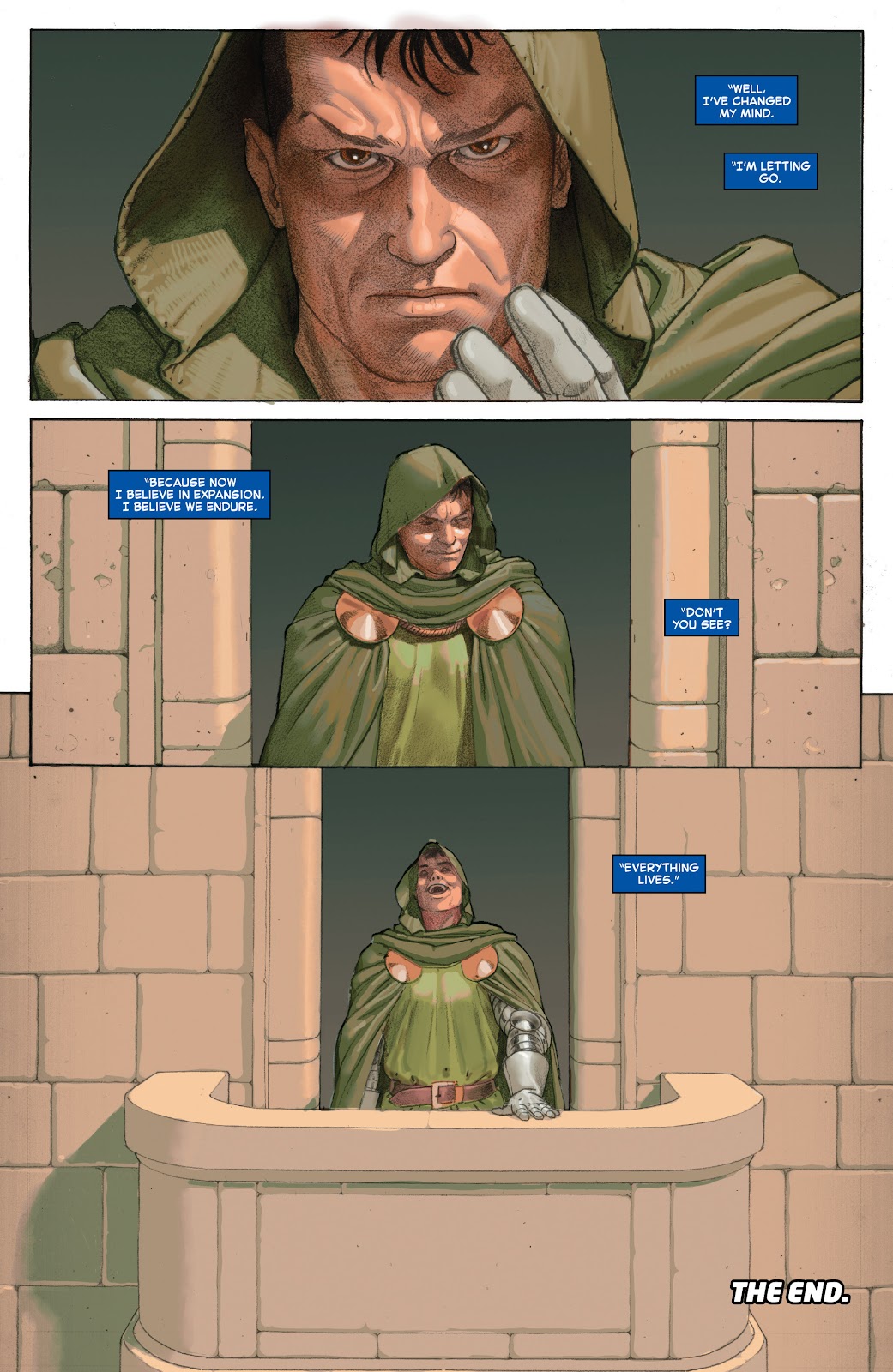
Doom may not be perfect, but in the words of his mom (she's back, by the way), he's on the right track.

I'm really thrilled with where this series is heading, and I'm excited to see what happens next. Unfortunately, it's not selling well, so who knows if this will last. That's a shame, because Marvel is still making good comics like this. It's just that they're not getting as much attention. At least, I can be happy that Doom’s legacy is not tainted by the current SJW sentiment going on in the comics right now (nor would he allow it to). I can only hope that more people support this comic, because I'd hate to see it given up on.

I would find it only fitting if Victor von Doom lived as both the greatest Marvel villain of all time and one of its greatest heroes.

While DC Comics may inspire people to be greater than themselves, Marvel is more down to Earth and represents the human struggle. I would argue that Victor von Doom is the best example of both, and of all the things I've found for this blog, I found this to be the perfect sendoff:

I certainly hope the readers of this have more respect for my favorite Marvel character now, and I thank you all for joining me.

I am Hero’s Shade, and I'll see you all…


NEXT TIME!